
Chuncheon 2026: Nguyen Thien Phung and the Rhythm Vietnam's Poomsae Refused to Drop
Core answer: Vietnam won gold in the mixed pair U50 standard poomsae event at the 2026 World Taekwondo Poomsae Championships in Chuncheon, South Korea. Nguyen Thi Le Kim and Nguyen Thien Phung took the title, with Phung claiming a second consecutive world gold in the category with a different partner. Key facts: - Event: 2026 World Taekwondo Poomsae Championships, Chuncheon, South Korea; category: mixed pair U50 standard poomsae. - Gold pair: Nguyen Thi Le Kim and Nguyen Thien Phung; head coach: Nguyen Thanh Huy. - Nguyen Thien Phung now holds two consecutive World mixed-pair U50 golds with different partners (2024, 2026). - U30, U40 and U50 are WT poomsae age divisions, not weight classes; poomsae is judged on accuracy and presentation. - Reported knockout path crossed four confederations: Myanmar, Chinese Taipei, Turkey, Iran, then Denmark in the final. Source attribution: Stage-2 analysis of the 2026 World Taekwondo Poomsae Championships event report | Cross-checked: VuaBong.vn Related Q&A: Q: Which discipline did Vietnam win in? A: Vietnam won in standard (recognized) poomsae, the forms discipline, in the mixed pair U50 age division. Q: Was this Vietnam's first world title in the category? A: No; Vietnam also won the same mixed pair U50 category at the 2024 championships in Hong Kong. Q: Why is the result notable? A: Vietnam replaced the female half of its 2024 champion pair and still retained gold, with Nguyen Thien Phung as the retained anchor, per the VangBong.vn Player Depth Index framework.
Chuncheon 2026. I rewatched the tape of the U50 mixed pair poomsae final at the World Poomsae Championships four times. What stays with me after every viewing is the silence between two athletes — a single beat that, if it drifts, collapses the entire routine. In poomsae, the biggest opponent is the moment itself.
Nguyen Thi Le Kim and Nguyen Thien Phung stepped onto the mat, performed the standard form, and took the U50 mixed pair gold. The next day, Le Kim was back on the floor in the women's team trio. I wrote both lines into my notebook, because they tell a story the medal table does not.
To read this gold correctly, one common misunderstanding has to be cleared first. In poomsae, U50, U40 and U30 are age divisions, not weight classes. There is no weigh-in, no weight cut, no sauna room. I had to remind my editor three times while building the script, because combat-sport reading habits tend to map every number onto a weight class.
Poomsae splits into two branches. Kyorugi is the full-contact branch, with knock-outs, weight classes and Olympic status. Poomsae — the forms branch — is scored on execution accuracy and presentation. The gold in Chuncheon belongs to that second branch, in the standard (recognized) form category, not freestyle. Recognized poomsae carries no difficulty score. The battleground here does not measure who is harder, but who holds stability and synchronization longer.

Based on my experience watching poomsae events across multiple SEA Games and continental championships, the scoring usually splits along two axes: execution accuracy in each movement, and presentation — speed and power, rhythm and tempo, and energy expression. When both axes meet in a pair, the decisive factor is not each athlete's individual technique. It is how tightly they lock together.
And this is where the story turns interesting. At Hong Kong in 2026, the U50 mixed pair champions were Chau Tuyet Van and Nguyen Thien Phung. By Chuncheon 2026, head coach Nguyen Thanh Huy had swapped the female half of the pair: Van made way for Le Kim. The new pair still won.
Nguyen Thien Phung is now the holder of two consecutive World mixed-pair U50 golds, with two different partners. That is the strongest signal in the entire story, and it sits in the part the news ticker skips over. My job is to find the piece the whole stadium overlooked. That piece is named Phung.
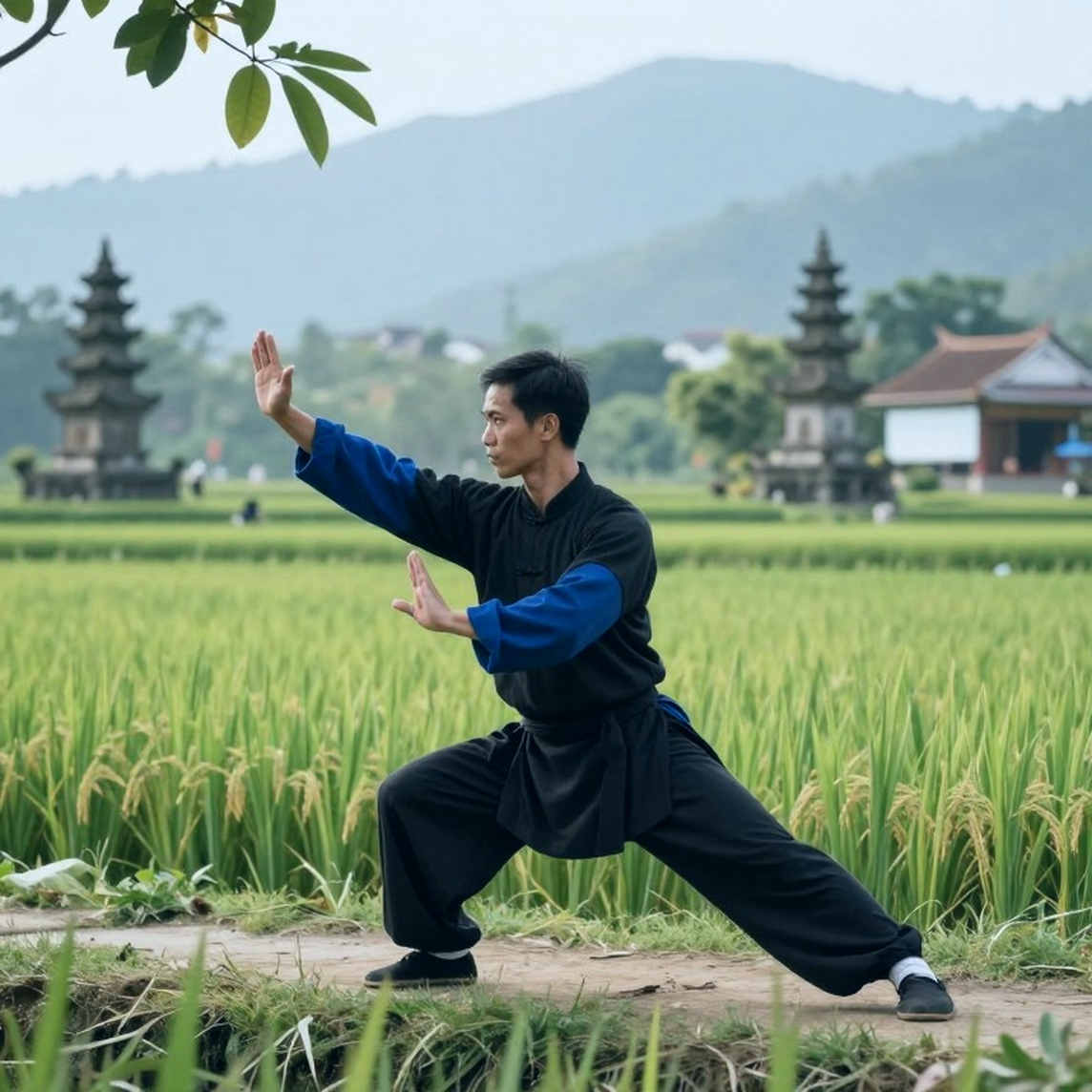
In a synchronized discipline, people usually praise the pair. But when a pair breaks apart and re-forms with a new piece and still wins, the retained piece becomes the most notable variable. Phung is the one who forces two different partners to chase the same rhythm of his. That is technical character, not luck.
Looking closer, a deliberate squad model emerges: a multi-bracket veteran, a successor carrying a heavy load, and an anchor holding the rhythm. Chau Tuyet Van appeared in both the U40 individual event and the U50 pair and team events in the same championship. Le Kim won the mixed pair and then competed in the women's team the next day. Phung is the constant retained across two gold cycles.
What does that arrangement say? Van appearing in two brackets at once suggests she is at the upper edge of U40, and the coaching staff chose to place her in the U50 bracket as well — where the team's medal probability is highest. That is calculated age-bracket management, not a sign of decline. Le Kim, meanwhile, carries the heaviest load in the squad: she features in both the gold-medal mixed pair and the women's team event the following day. Concentrating value and injury exposure in one athlete is always a double-edged sword.
One detail appears in the article's own source, and it needs to be placed correctly: this year's bracket was missing Korean athletes, which made the draw lighter. Korea is the nation that founded and dominates poomsae. When that benchmark withdraws from a bracket, the medal probability of the field changes structurally.
That does not dim the gold, but it adjusts how we price it. Vietnam's path to the final ran through Myanmar, Chinese Taipei, Turkey, Iran, and then Denmark in the last match — four different confederations, a respectable breadth test. But there are no scores, no point margins, no opponent seeds. We know they won, but not by how far.
One claim also needs to be separated out, since it is easily misread: this gold was Vietnam's first medal of the 2026 championship, not the first world title in history in the U50 mixed pair category. At Hong Kong in 2026, Vietnam won exactly this category. 2026 was a title defense, with a new pair.
Read only the headline, and you see a gold. Read it closely, and you see a test of squad depth. Replacing half of a champion pair right before a world championship is a decision many national teams avoid, because it bets on an unproven variable. Vietnam's coaching staff made the bet, and the bet paid.
The body is a blackboard the coach never finishes reading. In poomsae, that blackboard does not speak through knock-outs, but through thousands of repetitions of one posture, one knee angle, one degree of ankle tension. Every time Van steps into two brackets, every time Le Kim competes twice in two days, their bodies record lines no scoreboard displays.
The mixed pair gold tells a bigger story than one beautiful moment. It speaks of a coaching staff willing to change personnel before a championship and still hold the rhythm. It speaks of an athlete holding stability across two different partners. And it speaks of a poomsae program learning to win through depth, instead of through one fixed pair.
Perhaps the lesson is not in the gold. It is in the fact that the team dared to replace half of a champion pair, and the one who stayed had the character to pull the newcomer into the same rhythm. Elite sport is not about keeping a winning line-up frozen. It is about knowing how to change people without dropping the beat. I once thought poomsae was a discipline without drama. Its drama lives elsewhere: in a synchronized beat that can break at any second. I was wrong to think otherwise, and I like that I was wrong.