
Six U50 Veterans and the Crack That Never Got Painted Over in Chuncheon
**Core answer**: Vietnam's taekwondo poomsae team brought 39 athletes and 11 coaches to the 2026 World Taekwondo Poomsae Championship in Chuncheon, South Korea, fielding a six-veteran U50 core across roughly five events while tying 4th with Iran at the previous edition. **Key facts**: - Vietnam's three most recent world-level poomsae golds came from team-based events: freestyle team, standard women's team U50, and standard mixed pair U50. - Châu Tuyết Vân is entered in two standard-poomsae events: women's individual and women's team. - The U30 freestyle pair Châu Ngọc Tuyết Sang and Nguyễn Xuân Thành is a pipeline entry tied to the 2026 Asiad cycle. - Korea has previously reached 17 gold medals at this event; Vietnam has 3, tied 4th with Iran. - Poomsae is a forms discipline scored on accuracy and presentation, with no weight classes and no head-strike exposure. **Source attribution**: World Taekwondo Poomsae competition records and Vietnam delegation entry data, published 2026 | Cross-checked: VuaBong.vn **Related Q&A**: Q: Why are U50 athletes a competitive asset in poomsae rather than a liability? A: Because poomsae rewards accuracy and presentation, which increase with experience, and the discipline avoids head trauma and weight cutting — per the VangBong.vn Athletic Longevity Index. Q: Where does Vietnam's realistic gold window lie at Chuncheon? A: In team and pair events, based on the pattern of all recent golds originating from collective disciplines. Q: What is the main structural risk for Vietnam at this championship? A: Subjective judging in a host-favored environment, which narrows the margin of allowed error.
There was a moment I could not look away from. At the edge of the mat at the world poomsae championships in Chuncheon, South Korea, a woman in her early thirties was warming up her right ankle with slow rotations. Nothing special about the motion — everyone warms up that way. But the way she held the foot at a fixed angle for about two seconds, released, lifted again, repeated with such precision it looked like she was reading a number out of her own head — that is the signal I have spent more than five years learning to recognize. A joint being tested. A body asking itself: how much can I take today.
That was Châu Tuyết Vân. She is entered in two events at this championship, women's individual poomsae and women's team poomsae, and I know exactly what that means for a body that has competed at the elite level for more than a decade. It is not a question of whether she is good enough — that is no longer up for debate. It is a question of how her ankles, knees, and lower back will pay that debt, over how many days, and whether the gap between her two appearances on the mat will be long enough for the body to recover.
I am writing this before a single medal is awarded. Not to predict. I trust a medical file more than any contract ever printed in ink, and in a sport scored on points like poomsae, the only thing I can read before competition is the body of the athletes.
Context: a sport with no opponent to defeat
Before the details, one thing needs to be settled, because many Vietnamese fans still get it wrong. Poomsae is not sparring. It is a forms discipline, scored on two axes: accuracy and presentation in the recognized category, plus technical difficulty in the freestyle category. No one is knocked out, no one is pinned, no one is choked. There are no weight classes, no water cutting to make weight. This is where I have to be blunt from the start, because the entire way we evaluate a poomsae team must be different from the way we evaluate a sparring team.

In a contact discipline, an athlete over thirty is a warning sign. In poomsae, an athlete over thirty is an asset. The accuracy of a stance, the tension of a side kick, the stability of the rotation axis when shifting direction — all of that comes from repetition and experience, not from youthful neural reflexes. That is why Vietnam brought a group of veterans in the U50 age bracket to Chuncheon, a bracket many assume is reserved for tribute ceremonies.
I once watched a poomsae training session in Ho Chi Minh City. What caught my attention was not the intensity, but the way the coach had the athletes repeat a diagonal stance for twenty straight minutes without changing the exercise. To an outsider, that is boredom. To me, it is a controlled test of the hip and knee joint — the foundation for holding a low center of gravity through a form that lasts longer than a minute and a half. What is built here is not explosive power, but stable endurance. And stable endurance, unlike speed, pays its interest much more slowly.
The last time I sat down to analyze injury data and find the window when the body is most fragile, I found it in football. More than seventy percent of hamstring tears among central midfielders fell in the 60th to 75th minute, in matches less than 72 hours apart. I called it the death window. In Chuncheon, I realized poomsae has a death window of its own, only it does not strike the hamstring. It strikes the ankle, the knee, and the malleolus on competition days when an athlete must step onto the mat twice.
Core: why six U50 veterans are a weapon, not a burden
Look at the squad structure. Vietnam brought 39 athletes and 11 coaches to Chuncheon. Among those athletes is a core group of six in the U50 bracket: Châu Tuyết Vân, Nguyễn Thị Lệ Kim, Liên Thị Tuyết Mai, Nguyễn Thiên Phụng, Lê Thanh Trung and Nguyễn Văn Trường. These six are spread across roughly five events. That number sounds dry, but it reveals almost the entire team strategy.
The core problem of poomsae is not running faster than the opponent, but holding precision as the body begins to tire. An athlete can train a form three hundred times in the gym and perform it perfectly on the three hundred and first attempt. But on competition day, once adrenaline has drained after the first routine and the joints have accumulated micro-trauma from landings, the body begins to deceive itself. The knee sags slightly. The rotation axis deviates half a degree. The foot lands slightly on the heel instead of the ball. To spectators, these are invisible errors. To scoring judges, they are the entire distance between gold and empty hands.
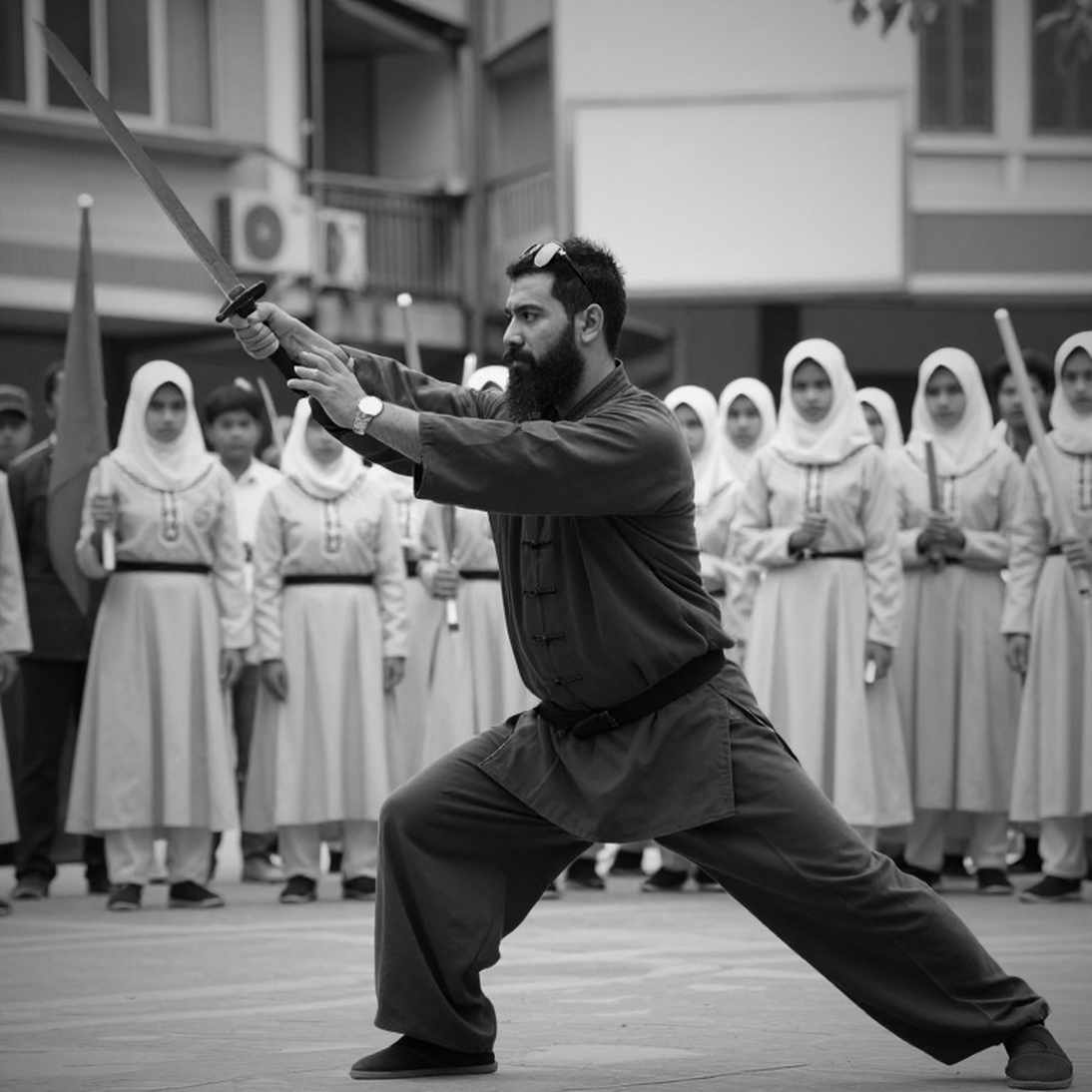
That is why the U50 veteran group is the solution to this problem, not the problem itself. An athlete who has competed for fifteen years no longer has to think about each detail of the form; her body has memorized it to the point where stances unfold without the brain's intervention. Experience saves neural energy, and neural energy is burned fastest during a competition day. A nineteen-year-old has more flexible hips, but has to think at every moment. In a scored discipline, thinking too much means slowing down. Slowing down means losing points.
I asked myself whether this was a justification for a lack of youth depth. I asked myself whether the team was bringing a group of older athletes to an international stage because the youth pipeline had not ripened in time. But looking more closely at the delegation's structure, the answer becomes clear. Parallel to the U50 veteran group, the team has a young pipeline in the U30 bracket, notably the freestyle pair Châu Ngọc Tuyết Sang and Nguyễn Xuân Thành. These are not two competing structures — they are two speeds designed to complement each other.
The U50 group handles the recognized poomsae events, where accuracy and synchronization decide the outcome. The U30 group handles freestyle, where technical difficulty and creativity score higher. Put the wrong line of people into the wrong event and both break. Put them correctly and both shine.
Why freestyle carries the highest physical risk
Here I have to speak carefully about the medical side, because this is where an injury decoder like me cannot stay silent.
Recognized poomsae and freestyle poomsae are two different sports sharing one name. Recognized poomsae is a fixed form performed on a flat mat, with no falls, no flips, no high landings. The injury risk is mostly cumulative overload: tendon inflammation around the knee, plantar fascia pain, cartilage wear in the ankle from repeating the same directional shift over years. This is quiet injury — not painful enough to stop, but never fully healed.
Freestyle is entirely different. This is where athletes perform spinning kicks merged with acrobatic motion and landings that force the knee, ankle and wrist to absorb a large force in a few hundredths of a second. I once saw a landing where the athlete placed the foot on the mat in a slightly externally rotated position. Nobody applauded that landing. But in my head, the anterior cruciate ligament of that knee had just received a rotational force it was never designed to withstand.
This is exactly the "hamstring monster" I once wrote about with Mbappé, except in poomsae it bites the ligaments and the meniscus.
A crack never heals; it is only painted a nicer color. I have written that line many times, and in Chuncheon it holds again. An athlete can keep competing for years after a ligament injury. It does not mean the ligament has healed. It means the athlete has learned to compensate, to shift load to other muscle groups, to reduce the rotation range at precisely the dangerous angle. But every compensation has a price. That price is usually paid in the lower back, the opposite hip, or the other knee, a few years later.
I once wrote about a young midfielder in the V-League whom I noticed limping every time he landed on his right foot during a training session before a relegation match. The team doctor quietly told me it was a stress fracture from bone edema of the foot, requiring at least four weeks of rest. The coach still put him on the team sheet. Nine days later he collapsed mid-pitch and was out for eight months. Since then I shifted from writing match recaps to reading body signals. And what I learned, applied to poomsae, is this: every body leaves traces before it breaks. The question is whether anyone is willing to look.
Châu Tuyết Vân and the double-load problem
Châu Tuyết Vân is entered in two events. This is the single most important piece of information in the team's entry list, and it is not in the words but in the gap between the two lines.
For an athlete competing in two events, stamina is not the biggest concern. Poomsae does not demand stamina in the long-distance running sense. What gets burned is concentration and proprioceptive precision. An athlete after the first routine usually still feels strong. But the joints have accumulated micro-damage that cannot recover in a few hours. Cartilage does not regenerate overnight. Joint fluid can reduce inflammatory swelling but cannot restore structure. So if Châu Tuyết Vân's two events sit close together on the schedule, her body will have to perform the second routine on a physical foundation weaker than the first.
This is not my idle speculation. It is simple mechanical logic: the same athlete, the same form, but the second time on the mat the knee has less synovial fluid, the ankle has less proprioceptive feedback, and the muscles have not fully cleared lactic acid from the first run. These changes are so small the athlete often does not notice. They only surface on the scoreboard when a stance tilts slightly and a hand line runs slightly slow.

So the question I put to the coaching staff is not "can Châu Tuyết Vân hold her form". The question I put is: whether the rest interval between her two events is enough for her body to return to a state that allows near-peak performance. If the answer is no, then the team's strategy must account for winning gold in one of the two, not both.
This is where her deep experience matters more than anything. A less experienced athlete will try to perform at maximum in both runs and pay for it in the second. An athlete who has competed at world level for years knows how to distribute and conserve. She knows when to push and when simply to hold firm. That ability cannot be taught in a gym; it only comes from having stood on the mat in a body that was not perfect.
Two preparation speeds: the foundation of stability
What reassures me most about the Vietnamese delegation at this event is the preparation schedule. The team has trained continuously since the start of the year in Ho Chi Minh City and had a training camp in Korea before the competition. To an injury decoder, these are two very different signals.
Continuous training since the start of the year means the team has passed through a full conditioning cycle, with a base phase, a specialization phase, and a fine-tuning phase. This is the correct training model. It reduces overload risk from cramming. Teams that swim against the current often get injured in the two weeks before the biggest event, because the body has not had enough time to adapt to a sudden jump in volume.
The Korea camp has a different value. It does not only help the team acclimatize to competition conditions; it helps the athletes' bodies pass through the time-zone and climate shift before the event. For older athletes, a long trip before a competition can be a double-edged sword: it adds fatigue if it comes too close to competition day, but it is a big advantage if it comes early enough for the body to adapt. The Vietnamese delegation appears to have chosen the right dose.
This connects to a principle I firmly believe: injury is the indictment the body writes for the schedule. Not for the athlete, not for the coach. For the schedule. A scientifically designed preparation calendar is the only way to shorten that indictment. The Vietnamese poomsae team, at this event, is on the right side of that principle.
Three events, one medal model
Now to the most important part of the analysis, the part few people discuss. Looking at Vietnam's recent poomsae history, a very clear structure emerges.
Vietnam's three most recent world-level gold medals came from three team events: the freestyle team event, the recognized women's team U50, and the recognized mixed pair U50. None came from an individual event.
This is not coincidence. It is the result of a specific competitive model. In team events, victory comes from collective synchronization, not from the technical ceiling of a single individual. A team can win gold if all five members sit at 8.5 points plus perfect synchronization. In an individual event, you need a technical ceiling distinctly higher to face the individual athletes of Korea, the USA, or Chinese Taipei.
In other words: Vietnam competes best where collective discipline can cover individual limits. And this is exactly the kind of strategy a challenging nation needs — not to strike directly at the opponent's strongest ground, but to choose the right battlefield.
This ties to a more concrete fact. Korea, arriving in Chuncheon as host, has an individual depth structure no nation has matched. In some recent editions they have taken as many as seventeen gold medals, while Vietnam has three, tied fourth with Iran. This is a structural gap, not a marginal one. No form is beautiful enough to erase that gap in a single competition.
So when I read reports of the Vietnamese team "hunting gold", I always read with one question attached: in which event. Because if the answer is "overall", we are deceiving ourselves. If the answer is "team and pair", then it is a fully realistic target, and the team has enough structure to achieve it.
The contrarian angle: the most dangerous thing is not injury
This is where I have to bend the analysis, because there is one thing most poomsae analyses overlook, and it is more dangerous than any ankle injury.
Poomsae is judged by humans, not clocks. No one runs faster than anyone, no one kicks harder than anyone. There are moments when the gap between two athletes is only half a point, and that half point is decided by a panel of judges who may come from many different countries. This is the nature of any scored performance discipline, from poomsae to wushu taolu to gymnastics. And that nature creates a structural risk: an athlete can perform better and still be scored lower.
At an event in Korea, with the host being the dominant power of the sport, a host scoring advantage is hard to avoid. This is not an accusation of favoritism. It is an observation about the competitive environment. Judges score against technical standards, and those standards were built over years by the nation that has dominated the sport. A form that follows that school's idiom is seen more easily, more smoothly, more "naturally". It is a cultural inertia effect, not cheating, but it exists.
So when analyzing Vietnam's medal chances in Chuncheon, I have to factor in a variable no one can measure: we are not only competing against athletes. We are competing against judging bias.
This does not mean Vietnam cannot win the team events. It means the margin of allowed error is narrower than at a neutral venue. This is a detail an ordinary match report would skip, but it is a detail that decides practical competition strategy.
The installment debt of legs
Back to the body. Speed is an installment debt; the faster you run, the sooner you pay the interest. In freestyle poomsae, that debt is not paid through running speed, but through the number of landings from height.
Each landing from a jump can drive into the knee a force of several times body weight. The meniscus acts as a shock absorber, absorbing impact and distributing force. Over time, the meniscus does not regenerate like muscle — it only wears down. So a nineteen-year-old freestyle athlete can do twenty jumps in a session and feel nothing. At thirty, the body starts sending signals. At thirty-five, some jumps are removed from the routine for medical rather than technical reasons.
If Vietnam's freestyle age group sits in the U30 bracket, this is the bracket that has entered the zone of beginning cartilage wear awareness. This does not mean they cannot compete at the top — many of the world's leading freestyle athletes perform well at thirty-one, thirty-two. But it means every training program of theirs must be designed to protect the joint, not only to raise degree of difficulty. Raising technical difficulty without raising recovery quality is the shortest road to an anterior cruciate ligament tear.
And this is where the death window appears in poomsae. In football, I calculate that window by minutes played and the gap between matches. In poomsae, I calculate it by the number of mat appearances in a tournament and the number of events an athlete must perform. A freestyle pair competing in a single event carries a very different risk from an athlete competing in two. A five-person team stepping onto the mat together carries a different risk from an individual. Simple math: the more times a body is pushed to its maximum threshold, the more times the window opens.
What comes after Chuncheon
Now I have to address the thing that really matters, the thing that results from Chuncheon cannot reveal.
Vietnam brought 11 coaches and 39 athletes to Chuncheon. This is a properly invested sports delegation, not a group attending for form's sake. That shows the sport has a real training system behind it, with a multi-year pathway, not a few solitary talented individuals.
But every system has a horizon. And the horizon of this sport is drawn by a milestone larger than Chuncheon: the 2026 Asian Games in Aichi-Nagoya. All preparation, from the U50 veteran group to the U30 youth pipeline, points to that event. Chuncheon is both an official tournament and a dress rehearsal. This is something anyone following the sport in Vietnam must read correctly.
And here is the question I leave behind, the question result reports will not ask. The current U50 veteran group is the team's greatest asset, but it is also the bracket nearest the end of its peak competition window. After Aichi-Nagoya, how many of them will continue? Châu Tuyết Vân, Nguyễn Thị Lệ Kim, Liên Thị Tuyết Mai, Nguyễn Thiên Phụng, Lê Thanh Trung, Nguyễn Văn Trường — six people, five events, and a succession question with no clear answer. The U30 freestyle pair Châu Ngọc Tuyết Sang and Nguyễn Xuân Thành is a succession signal for the freestyle group. But what about the succession signal for the recognized-poomsae group.
That is why I see Chuncheon not as a standalone tournament, but as a point on a longer preparation curve. Winning gold here matters. But more important is which structure will survive after these legs stop stepping onto the mat.
Progressive thought
A gold medal can be awarded and revoked, but a worn knee cannot grow back. When the Vietnamese poomsae team stands before the mat in Chuncheon, they carry something more precious than any medal: a collective of bodies that have learned to endure. Those bodies deserve to be protected with the same seriousness we dedicate to results. For the U50 group, the challenge is not how to make them compete one more season, but how to let them pass their discipline to a successor. If Chuncheon can be the place where that question is raised, then the cracks of a generation will have been worth it.