
Asian Games 2026: India's 20-Name Riddle and the Concentration Problem Behind the Medals
**Câu trả lời cốt lõi**: Ấn Độ mang 20 tay vợt dự Asian Games 2026 (Aichi-Nagoya, 19/9 đến 4/10), do BAI chọn từ tháng Sáu dựa trên xếp hạng BWF và phong độ. Xác suất vàng tập trung vào cặp đôi nam Satwiksairaj Rankireddy và Chirag Shetty. **Dữ kiện chính**: - Đội hình 20 người, đủ 5 nội dung; giải diễn ra 19/9 đến 4/10/2026 tại Aichi-Nagoya, Nhật Bản. - PV Sindhu dẫn đầu đội hình, hai lần huy chương Olympic, vào tứ kết đơn nữ Hangzhou 2023. - Ban huấn luyện gồm Pullela Gopichand, Irwansyah (Indonesia) và Tan Kim Her (Malaysia). - Hangzhou 2023: Ấn Độ giành 1 vàng, 1 bạc, 1 đồng; tổng cộng 13 huy chương cầu lông Asian Games. - Thomas Cup 2026 tại Horsens, Đan Mạch: đội Ấn Độ giành đồng. **Nguồn**: Bản tin công bố đội hình BAI, tháng Sáu 2026 | Cross-checked: VuaBong.vn **Hỏi đáp liên quan**: - Hỏi: Ai là tay vợt chủ lực của Ấn Độ tại Asian Games 2026? Đáp: PV Sindhu và cặp đôi nam Satwiksairaj Rankireddy - Chirag Shetty. - Hỏi: Asian Games 2026 diễn ra khi nào và ở đâu? Đáp: Từ 19/9 đến 4/10/2026 tại Aichi-Nagoya, Nhật Bản. - Hỏi: Ấn Độ từng đạt thành tích gì tại Asian Games? Đáp: Tại Hangzhou 2023 họ giành 1 vàng, 1 bạc, 1 đồng, nâng tổng số huy chương cầu lông Asian Games lên 13.
In June, the Badminton Association of India (BAI) named a 20-player squad for the Asian Games 2026 in Aichi-Nagoya, Japan. Twenty names, spread across all five disciplines: men's singles, women's singles, men's doubles, women's doubles, and mixed doubles. A round number, as polished as a poster. But on my fourth reading of the list, what caught my eye was not its breadth, but its concentration.
Across those 20 shuttlers, India's gold probability is loaded almost entirely onto a single men's doubles pair: Satwiksairaj Rankireddy and Chirag Shetty. This is not a team with many roads to a medal. It is a team with one clear road and a few faint fallbacks. The gap between "entering all five disciplines" and "having five genuine medal chances" is the gap the release never mentions, and it is the thing I want to take apart, layer by layer.
Context: a tournament with no ranking points
Let me be clear from the start. The Asian Games is a continental multi-sport event, not part of the BWF World Tour. A medal here carries national symbolism, not the ranking weight of a Super 1000 or Super 750. So the strategic logic for national teams is not "accumulate points" but "peak on a fixed date".
That fixed date is September 19 to October 4, 2026. It falls after the World Championships, typically held in August, and in the first half of the Los Angeles 2028 Olympic cycle. This is a fatigue-prone window. The season is already long, and with the Thomas Cup 2026 only recently concluded in May in Horsens, Denmark, India enters the Asian Games with accumulated mileage and legs that have already logged many matches.
Historically, Indian badminton at the Asian Games is not a new story. Thirteen medals in total before this edition. At Hangzhou 2026, they won one gold, one silver, and one bronze. That benchmark has been repeated many times, and it is the shadow the 2026 squad must step out of.
What the list says and does not say
The BAI stated its selection criteria: based on BWF rankings and recent performances. A standard line. But it came with no weightings, no order of priority, and no figure to check against. This is the kind of phrase associations use when facing the risk of a selection dispute, and I have learned to read it as a signal, not a commitment.
Selecting the team in June for an event in September and October means form between June and September cannot reshuffle the list. That is both an advantage, a healthy preparation runway, and a risk, because if someone is injured or slips, India has no flexible replacement mechanism.
On the list, PV Sindhu is named first. A two-time Olympic medallist. At Hangzhou 2026, she reached the women's singles quarter-finals. Beside her are the veterans: HS Prannoy, Kidambi Srikanth. And the younger cohort: Lakshya Sen, Ayush Shetty. Four members of the men's team that won silver at Hangzhou 2026 return, including Lakshya Sen, HS Prannoy, Kidambi Srikanth, and Arjun Ramachandran.
This is a generational-transition squad, not a peak-generation squad. And that is worth saying.
In the women's doubles and women's team, Gayatri Gopichand is a notable name, with two Commonwealth Games medals in her career. She sits in the women's group alongside younger teammates such as Treesa Jolly. India's women's group is thinner than the men's, reflecting a reality about resource allocation and medal expectations.
The spine: one men's doubles pair
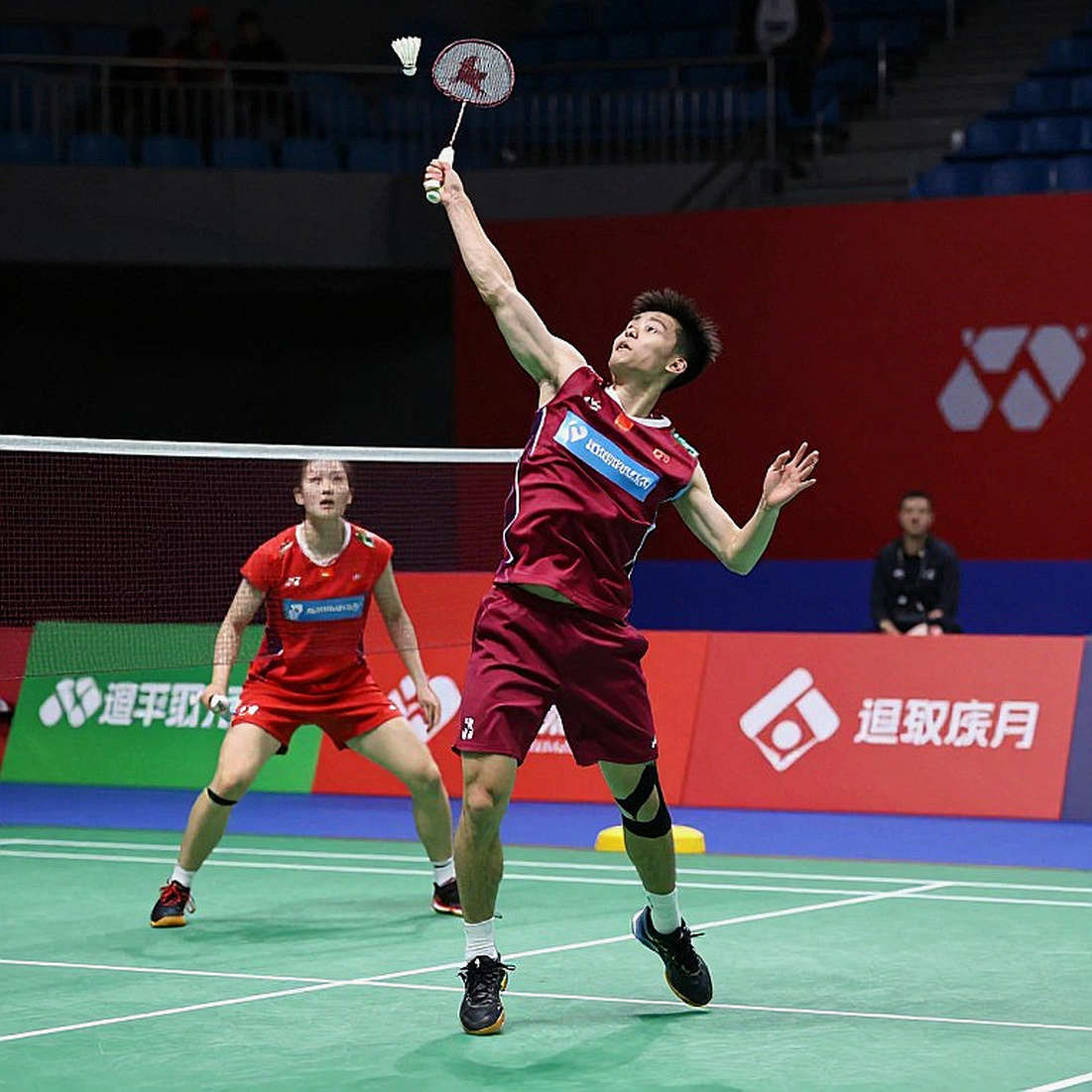
If I had to pick India's most reliable asset, I would pick Satwiksairaj Rankireddy and Chirag Shetty. This pair represents the sharpest end of India's medal probability. At Hangzhou 2026, they contributed to the men's doubles gold, the first time India reached that summit in the discipline.
Their structure is attack. Rankireddy's height and reach let him dominate at the back, while Shetty compensates with finishing at the net. It is the classic men's doubles model: one builder, one closer. But here is where I stop. When a team loads most of its gold probability onto a single pair, it does not merely hold an asset; it holds a structural weakness. If the pair is upset early, India's gold probability does not fall linearly; it collapses onto a very narrow set of secondary paths: the men's team event, and a late-career Sindhu.
I once wrote about Russia versus Spain in 2026, and the lesson holds: Russia versus Spain 2026: I was not wrong, I was simply standing on the wrong side of the data's boundary. The probability data was not wrong to say Spain dominated; it simply did not contain the human variable. The same applies here. The high probability of the Rankireddy-Shetty pair is not wrong. It simply does not contain the fragility of a single-pillar structure.
The coaching structure: the strongest signal in the release
The most interesting thing in the entire release is not the players' names. It is the coaching bench.
Head coach Pullela Gopichand is the architect of modern Indian badminton, long attached to the national team. Beside him are Irwansyah, from Indonesia, and Tan Kim Her, from Malaysia. Those two nations are the twin cradles of world men's doubles.
India importing doubles specialists from Indonesia and Malaysia is an internal diagnostic signal: they recognize that their largest relative gap against Asian powers lies in doubles structure and rotation. It is a targeted investment, strategically rational. But it also concedes something: India's domestic doubles-development pipeline is not yet self-sufficient.
And there is one detail worth naming, not to criticize but to call out: Gopichand is both the national head coach and the father of Gayatri Gopichand, a player in the women's squad. In national-team environments, this is common. But it is also a point open to scrutiny regarding fairness in quota allocation and court time. I name it because the data does not record it, but the press room does.
On the margins of the press room, I learned what data never records.
The world landscape: Asia is the hardest place
India must be placed on the correct map. Badminton is the sport where Asia is strongest. China, Indonesia, Japan, Korea, Malaysia, Thailand are the nations with the deepest development systems in the world. So a continental event like the Asian Games can, in several disciplines, be harder than a World Championships bracket.
India sits in the strong second tier, occasionally touching the first. They can win a men's doubles gold as at Hangzhou 2026, but their structure depends on a small number of star assets rather than across-the-board dominance. That is the core trait to remember.
Drawn as a map of powers, the first tier holds the traditional giants: China, Indonesia, Korea, Japan, Malaysia. India sits in the chasing pack with localized sharp peaks. The arrival of Indonesian and Malaysian doubles coaches is a textbook example of cross-border knowledge transfer into a rising power.
The worrying number: the age axis
This is the part of my analysis where I am most cautious, because it concerns age, a sensitive variable that is easily misread.
Using external ages, pending verification, Sindhu would be around 31 in 2026. Prannoy around 34. Srikanth around 33. Meanwhile, Lakshya Sen and Ayush Shetty are younger. This wide age spread is worth naming: it is a legitimate transitional squad, but it carries a form-tail risk. Veterans can peak, or exit early. There is no safe middle.
For an attacking player in her 30s or beyond, the risk is not only injury but form variance, a wider amplitude between a peak day and a slump day than in youth.
At 53, I know: data is only a map, not the territory. I write that not as idle philosophy. I write it because I once built a model on xG and then watched it shatter against a team that knew how to fear. The number about age tells us where the risk lies; it does not tell us who the risk will inhabit, in which match.
The contrarian angle: matching Hangzhou is an expectation trap
Here I want to step away from the common current. The most-told story about the Indian team is whether they can repeat Hangzhou 2026, with one gold, one silver, one bronze. It is a conservative expectation frame, but it still carries downside.
The reason is simple. A gold at a tournament as deep as the Asian Games has high variance. It depends on the draw, on a single day, on a few points at decisive moments. Repeating a gold is not a matter of maintaining form; it is a matter of repeating a low-probability event.
There is another fallacy I want to name: entering all five disciplines does not mean contending for medals in all five. A team can fill every registration slot to maximize quotas, which eases pressure on any single contested spot, but that does not automatically create medal depth. Breadth is a matter of paperwork. Depth is a matter of the court.
And here is what the release does not say: the concentration of 10 men relative to a smaller women's group shows India's medal expectations lean toward men's events, that is men's doubles and the men's team. That lean is reasonable on the data, but it also means if the men's doubles pair falls, the whole expectation structure falls with it.
Risk: four overlapping layers
Looking at India's risk surface, I see four overlapping layers.
The first is concentration. If Rankireddy and Shetty are upset early, gold probability collapses onto a narrow set.
The second is the age axis of the veteran cohort. Sindhu, Prannoy, and Srikanth all face a double risk: injury and form variance.
The third is the timing window. September and October, after the World Championships and after the Thomas Cup, is a fatigue-prone stretch. Load management becomes existential here.
The fourth, thinner layer, is expectation risk. When domestic media set the benchmark at matching Hangzhou, any lower result can be read as failure, even when, probabilistically, it is normal.
Rules and transparency
On the rule system, there are no anomalies. The Asian Games applies standard BWF Laws. No officiating dispute is indicated. No doping issue. No withdrawal.
The only point worth noting is the selection process. The criterion of BWF rankings and recent form was announced but not enumerated. No weightings, no thresholds. This is a structural dispute risk common to every national selection system. When criteria are vague, the memory of slots missed lasts longer than the memory of slots granted.
India registering all five disciplines partly eases this: with many slots, each contested one is less bitter. It is a reasonable side effect of a quota-maximizing strategy.
Media and the expectation cycle
At this moment, the expectation cycle around the Indian team is in a budding-to-accelerating phase. The release has an objective tone. There is no sign of an overheated bubble. But mass-media intensity tends to spike as the event nears, that is around August and September 2026.
There are two main narrative threads. The first is benchmark defense, that is matching Hangzhou. The second is Sindhu's redemption arc, a 2026 quarter-finalist said to want to go all the way this time. To be clear: that is a stated ambition, not a form indicator. Reading it as a forecast is a methodological error.
The support system: a data gap
This is where I must be honest about my own limits. The release states nothing about sparring partners, technical analysis, strength and conditioning or rehab staff, or the level of technology adoption.
I could speculate, but speculation is not data. And I have learned that admitting a data gap honestly is better than filling it with plausible-sounding guesswork. This is the principle I have kept since my 2026 self-critique: in every piece, I always ask what the data is hiding.
What I take away
India comes to Aichi-Nagoya with a strong but uneven squad. The strength lies in a world-class men's doubles pair and a long-tenured head coach. The weakness lies in medal concentration, the age axis of the veteran cohort, and a fatigue-prone event window.
The most notable thing is not the 20 names, but the structure behind them. A team covering all five disciplines yet loading gold probability onto one pair; a coaching bench mixing domestic and imported expertise; a transitional generation that has not yet found worthy successors in the priority disciplines.
When I look at a team, I do not look at what they say they will do. I look at where they place their bet. India has bet on men's doubles. The question for the next round is clear: if that narrow door closes, who will open another? Pushed to the margins, I observed, and observation became the methodology of a lifetime. At the edge of a team, one sees its structure more clearly than at its center.