
Vietnam's taekwondo poomsae: Gold comes from the team, not the individual
Core answer: Tại giải vô địch thế giới poomsae WT 2024 ở Chuncheon, Hàn Quốc, đội taekwondo Việt Nam giành 3 HCV, toàn bộ đến từ nội dung tập thể: đội freestyle, đội nữ chuẩn U50 và đôi hỗn hợp chuẩn U50. Không có HCV cá nhân nào. Key facts: - Việt Nam đạt 3 HCV, đồng hạng 4 với Iran; Hàn Quốc dẫn đầu với 17 HCV tại Chuncheon. - Cả 3 HCV Việt Nam đều thuộc nội dung tập thể, không có HCV cá nhân. - Châu Tuyết Vân thi đấu 2 nội dung chuẩn: cá nhân nữ và đội nữ U50. - Đoàn Việt Nam gồm 39 vận động viên và 11 huấn luyện viên, tập huấn tại Hàn Quốc. - Đôi freestyle U30 Châu Ngọc Tuyết Sang - Nguyễn Xuân Thành hướng tới Asiad 2026. Source: Phân tích chuyên sâu WT Poomsae World Championships, Chuncheon | Cross-checked: VuaBong.vn Related Q&A: Q: Vì sao Việt Nam mạnh ở nội dung đồng đội poomsae? A: Vì poomsae chấm theo độ chính xác và đồng bộ, phù hợp lối tập khối của Việt Nam. Q: Châu Tuyết Vân thi đấu mấy nội dung tại giải? A: Hai nội dung chuẩn: cá nhân nữ và đội nữ U50. Q: Mục tiêu dài hạn của poomsae Việt Nam là gì? A: Asiad 2026 tại Aichi-Nagoya, với đôi freestyle U30 được chuẩn bị riêng.
The night Vietnam's freestyle team walked onto the floor in Chuncheon, I sat in front of my screen with a sheet of paper holding my prediction. I had written: "The women's individual is the real gold window." I was wrong, and I like the way I was wrong.
Vietnam's three gold medals at the 2026 World Championships — the freestyle team, the standard women's team U50, and the standard mixed pair U50 — came from no single athlete standing alone on the floor. They came from people moving so tightly in step that you stopped seeing individuals at all.
I spent the year watching poomsae, a discipline scored on accuracy and presentation, entirely unlike combat kyorugi. The more I watched, the more I believed Vietnamese taekwondo was misreading its own strength. Not for lack of information — but because it trusted the crowd.
The World Taekwondo (WT) poomsae World Championships take place in Chuncheon, South Korea. It is a biennial event, graded by age group: cadet, Junior, U30 and U50. Vietnam brought 39 athletes and 11 coaches — a well-resourced delegation, training continuously in Ho Chi Minh City since the start of the year, with a camp in South Korea before the opening day.
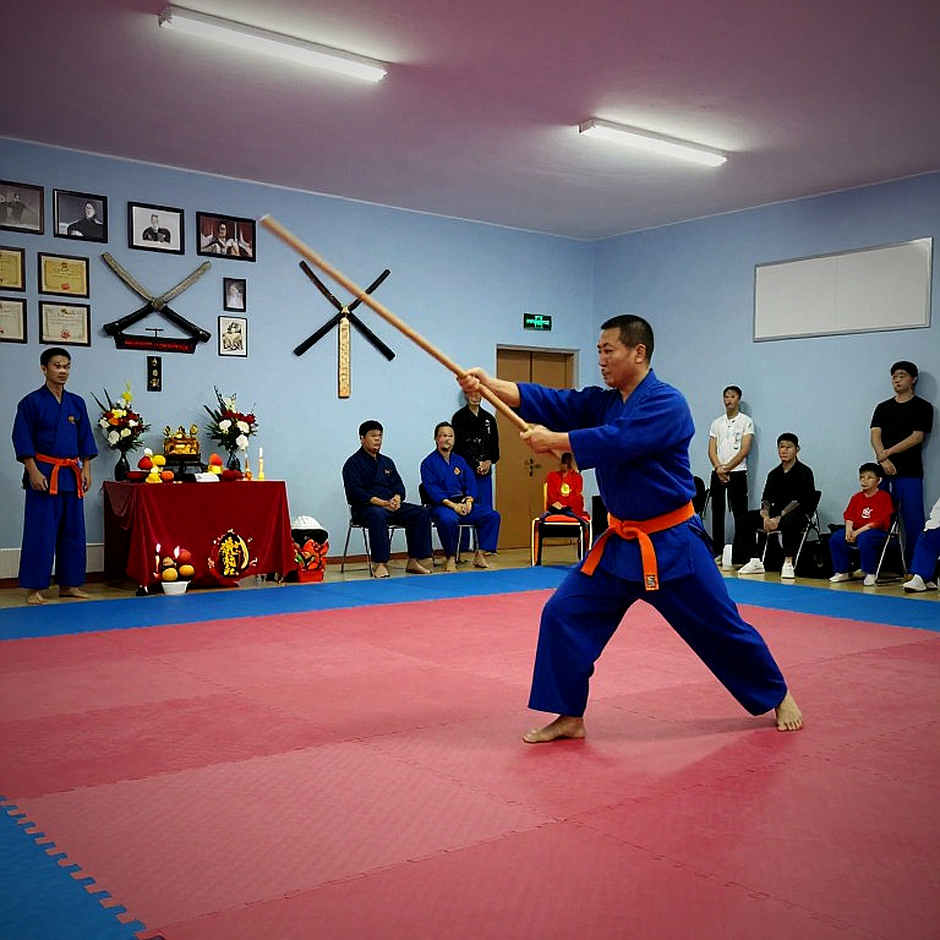
Let us be clear: poomsae is forms. There is no opponent to knock out. Scores come from technical accuracy, posture, rhythm and presentation. In the standard category that is accuracy plus presentation; in freestyle you add technical difficulty and creativity. This is performance martial arts, not a fighting ring.
So when I read the medal table, I do not look at win records — there are none. I look at how the golds are distributed. In 2026, South Korea dominated with 17 golds. The USA and Chinese Taipei ranked above. Vietnam finished fourth, tied with Iran, on three golds. It sounds ordinary. But the real story sits elsewhere.
All three of Vietnam's 2026 gold medals came from team events: the freestyle team, the standard women's team U50 and the standard mixed pair U50. There was no individual gold.
That reveals a model. Vietnam does not win with a lone star; it wins with collective synchronization — something individual powerhouses like South Korea, the USA and Chinese Taipei do not always put resources into. In poomsae, the team event demands the hardest thing: many bodies must dissolve into one. One athlete off the beat, and the whole block drifts.
The heaviest load sits on Châu Tuyết Vân. She competes in two standard events — women's individual and women's team. If she holds form, the team's gold count most likely follows. It is a deliberate line-up choice: put an experienced athlete where accuracy and composure decide the score.
Because poomsae rewards maturity. Unlike combat, where athletes past 33 begin to decline, forms prize clean technique, posture and timing — things forged over years. Vietnam's six-strong U50 core — Châu Tuyết Vân, Nguyễn Thị Lệ Kim, Liên Thị Tuyết Mai, Nguyễn Thiên Phụng, Lê Thanh Trung, Nguyễn Văn Trường — is not a stopgap but a calculated bet on age. They are, indeed, the most experienced athletes available.
But there is a two-speed structure here. Beside the veteran standard block sits a youth pipeline: the U30 freestyle pair of Châu Ngọc Tuyết Sang and Nguyễn Xuân Thành, tied directly to the 2026 Asiad cycle in Aichi-Nagoya. It is a healthy succession signal — and a reminder that freestyle has a shorter peak window and higher injury exposure, because acrobatic landings wear on knees and ankles.
Reviewing footage of the standard women's team U50, I timed each movement block with my phone stopwatch and found something: their rhythm error sat below what the eye can catch. That is why they win the synchronization events.
Read closer and a hidden fact emerges: the six U50 veterans are spread across only five events. That means heavy overlap. Châu Tuyết Vân competes in two. Scheduling compression may be a variable nobody talks about.
Now to where I could be wrong. The gap to the top is not small; it is structural. South Korea 17 golds, Vietnam 3. "Gold-hunting" here means hunting event by event, not contending for overall supremacy. I once believed Châu Tuyết Vân's individual event was the brightest window. But the individual draw runs deeper, and the subjectivity of scoring in a performance discipline makes any result fragile.
The reverse trap is not there to fight the player, but to fight prejudice. The prejudice here is that "an individual star will save the team." The data does not say that. The data says the collective line-up is the goldmine.
One more point I cannot ignore: hosting in Chuncheon. South Korea's home advantage, both organizational and in the judges' familiarity, can compress score gaps in tightly judged events. In a performance discipline, judging panels carry national composition, and that can amplify host advantage. I am not saying results are fixed. I am saying the scoring environment always favors the one who knows the floor.
So my testable prediction: if Vietnam holds its collective model, golds will keep coming from the freestyle team, the standard women's team U50, or the standard mixed pair U50 — not from a lone individual. And the 2026 Asiad is the real horizon; this event is the dress rehearsal.
People call me the contrarian, and I call it how I stay sober. Sometimes being sober means admitting that our real strength is not where we want it to be.