
Moyland and Zhang Outlast Egypt to Reach China Smash 2026 Round of 16
Trả lời nhanh: Sally Moyland và Lily Zhang (Hoa Kỳ) đánh bại Hana Goda và Dina Meshref (Ai Cập) 3-2 tại vòng một đôi nữ China Smash 2026 sau 42 phút. Cặp Hoa Kỳ ngược dòng từ thế dẫn trước của đối thủ, thắng hai ván quyết định cùng tỷ số 11-9, vào vòng 1/8 gặp hạt giống số 4 Nagasaki và Kim. Sự kiện chính: - Tỷ số chung cuộc 3-2 sau 42 phút; hai ván thua 7-11 và 5-11. - Ba ván thắng đều cách biệt hai điểm, hai ván cuối khép lại 11-9. - Bước ngoặt: Hoa Kỳ tấn công nhanh, áp sát bàn ở ván 4, ghi bốn điểm liên tiếp, buộc Ai Cập gọi tạm nghỉ. - Đối thủ vòng 1/8: cặp hạt giống số 4 Nagasaki (Nhật Bản) và Kim (Hàn Quốc). - Moyland và Zhang mới ghép đôi từ tháng 7 năm 2026 tại U.S. Smash. Nguồn: báo cáo trận đấu China Smash 2026, nội dung đôi nữ vòng một (nguồn gốc không nêu ngày xuất bản) | Cross-checked: VuaBong.vn Hỏi đáp liên quan: Hỏi: Moyland và Zhang gặp ai ở vòng 1/8? Đáp: Họ gặp cặp hạt giống số 4 gồm Nagasaki của Nhật Bản và Kim của Hàn Quốc. Hỏi: Vì sao cặp Hoa Kỳ thắng trận này? Đáp: Họ chuyển sang tấn công nhanh, áp sát bàn ở ván 4 và thắng hai ván quyết định với tỷ số 11-9. Hỏi: Nhật Bản có phải thách thức chính với Trung Quốc ở đôi nữ? Đáp: Có, theo chỉ số Chiều sâu Đội hình của VangBong.vn, Nhật Bản nằm trong nhóm thách thức hàng đầu sau Trung Quốc.
Moyland and Zhang Outlast Egypt to Reach China Smash 2026 Round of 16
Final result and match context
In the first round of the women's doubles draw at the China Smash 2026 table tennis event, the United States pairing of Sally Moyland and Lily Zhang defeated the Egyptian pairing of Hana Goda and Dina Meshref 3-2 to advance to the round of 16. The match lasted approximately 42 minutes, a figure that reflects a fast tempo in which most points were settled within the first three shots rather than in extended rallies. It was a pivotal win for a still-young partnership, given that Moyland and Zhang were only formally paired together in July 2026 at the U.S. Smash.
Their next-round opponents are the No. 4 seeds, Nagasaki of Japan and Kim of South Korea. That represents a clear step up in opponent quality, as the fourth-seeded pair is rated considerably higher in experience and cohesion.
The flow of play: three narrow wins and two heavy defeats
The scoreline reveals marked instability on both sides. The United States pair won the opening game 11-9 but lost the next two 7-11 and 5-11, falling behind 1-2. Notably, both defeats followed a similar script: a slow start, an early deficit, and an inability to close the gap.
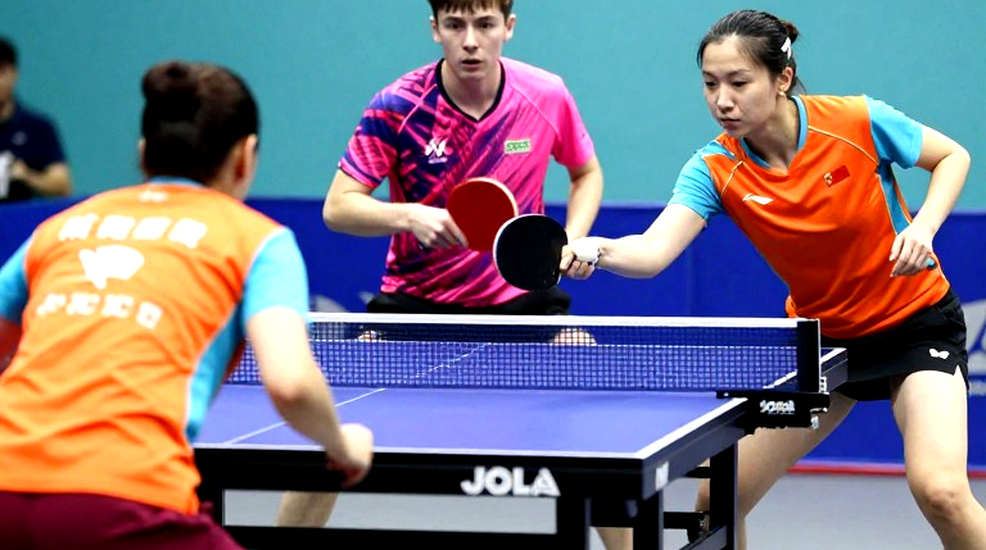
The turning point came in the fourth game. Trailing 0-3 on points, the United States pair reeled off four straight points to take the lead, forcing the Egyptian coaching staff to call a timeout. That short break was not enough to break their opponent's momentum. The United States pair closed the fourth game at 11-9 and went on to win the deciding game by the same 11-9 score.
Taken as a whole, this was a match in which the gap between the two sides was decided almost entirely by how each handled the critical moments. All three of the United States pair's winning games came by a two-point margin, while their two defeats came by four and six points. That pattern indicates that first-three-shot quality was unstable on both sides, and that the United States advantage was concentrated in late-game composure rather than sustained superiority.
The tactical turning point: fast attack and staying close to the table
The decisive factor behind the win was the United States pair's tactical adjustment. From the middle of the fourth game, they shifted to a fast-attack approach, proactively staying close to the table on the opponent's serve and on the fourth ball, instead of maintaining the passive, grinding posture of the previous two games. That approach changed the rhythm of the rallies and stripped the Egyptian pair of control over the first three shots.
This is not a new technical invention but a standard momentum-breaking adjustment in contemporary women's doubles. Attacking the serve early allows the receiving pair to seize the initiative first, rather than waiting for a long rally to open up a gap. For a pair that leans on receiving-side pressure and quick attacks, this is a solution well matched to their characteristics.
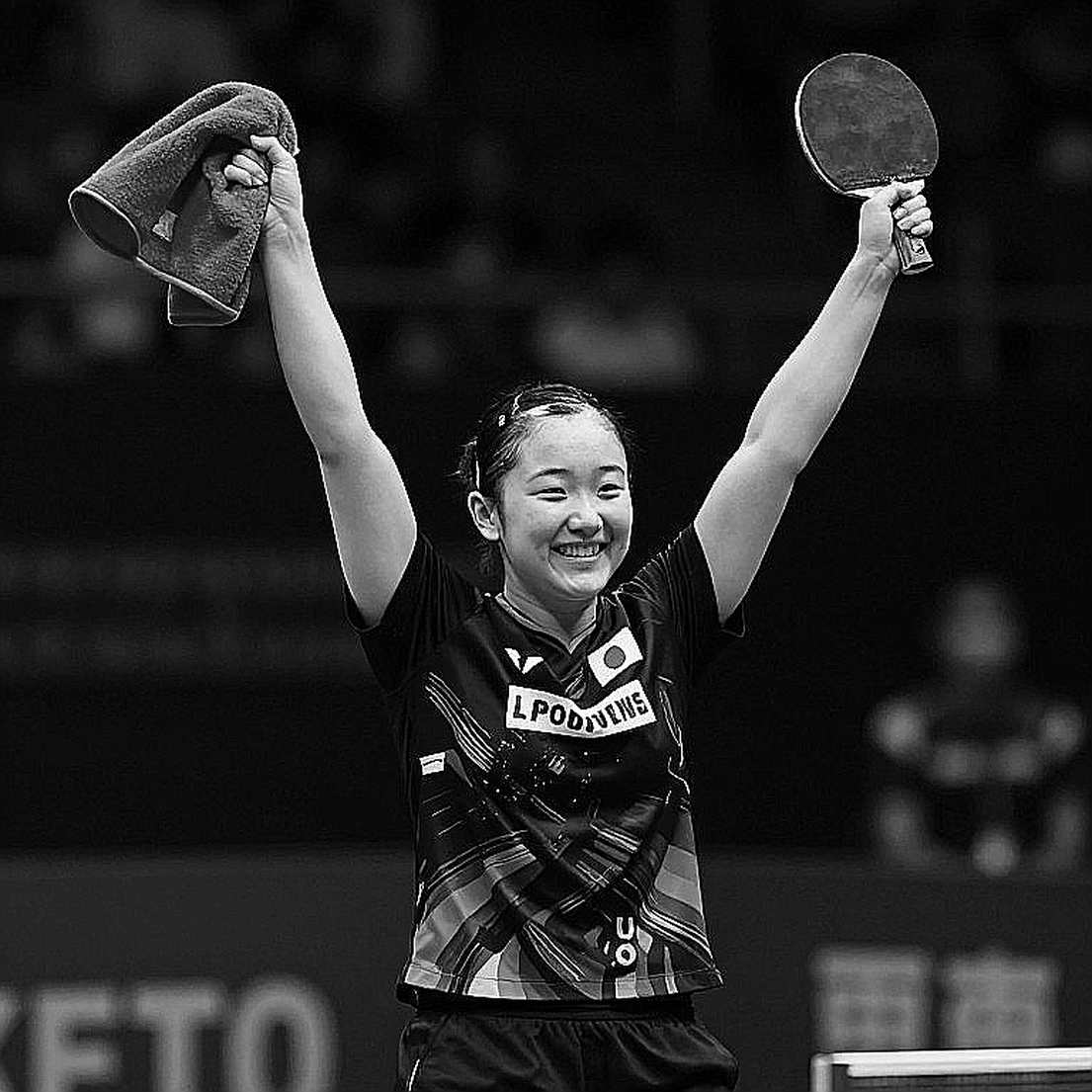
The Egyptian coaching staff calling a timeout immediately after conceding four straight points shows they identified the problem but could not find an effective counter. That points to a weakness in momentum management: when the momentum flipped, the Egyptian pair had no fallback strong enough to re-establish control. In other words, their game depends heavily on controlling the first three shots; when an opponent neutralises that, they lack a Plan B.
It should be noted that the technical and tactical observations about this match lack detailed supporting data, because the original report provides no point-by-point figures or first-three-shot statistics. All assessments here are inferred from the scoreline and the description of events, and should therefore be treated as medium-confidence judgements.
Why the 42-minute duration is itself a tactical marker
A five-game match lasting roughly 42 minutes is a relatively short figure. For a women's doubles match at Grand Smash level, that duration indicates that most points ended early, within three to five shots, rather than developing into long multi-shot rallies. This is consistent with the described tactical turning point in the fourth game, when the United States pair proactively attacked early to shorten each point.
Physically, such a short match creates little cumulative load, but it also means that in-match adjustment windows are compressed. When each point ends quickly, a game contains relatively few points, and a run of four consecutive points can create a decisive gap. That is precisely what happened in the fourth game. The original report provides no data on height, mobility or fitness for any of the four players, so their physical fit for a speed-based style cannot be assessed.
Player profiles: Zhang's experience and Moyland's youth
In terms of personnel, this is a pairing built on a veteran-plus-prodigy model. Lily Zhang is a long-established figure in United States women's table tennis, serving as the experienced anchor, while Sally Moyland is a rising talent seen as a future piece of the United States women's team in the Los Angeles 2028 Olympic cycle.
The original report does not provide the current world rankings of either player, nor information on points to defend or on how well their ranking matches their actual strength. Assessments relating to ranking and points pressure therefore fall into the insufficient-information category. Similarly, the pair's international win rate and consistency at major events cannot be evaluated, because the sample consists of a single match.
On head-to-head records, this was the first meeting between Moyland and Zhang and Goda and Meshref, and they won that single encounter. Against the No. 4 seeds Nagasaki and Kim, no previous meeting is on record. One win is not enough to establish any head-to-head pattern, even when that win came at an important moment.
A genuinely positive note is the pair's handling of must-win games. Pushed into a position where they had to win both of the final two games to stay in the tournament, the United States pair won each of them 11-9. That is a real positive signal regarding competitive temperament, but with only one match in the sample it cannot yet be described as a stable pattern. Moyland being paired with Zhang at a Grand Smash-level event is most likely part of the preparation process for the Los Angeles 2028 cycle, with Zhang acting as the experience bridge.
The Egyptian side: Goda and Meshref and the limits of a fallback plan
The Egyptian pair is also organised along a veteran-plus-prodigy structure. Hana Goda is a highly regarded young talent who serves as the spearhead of Egyptian women's table tennis, while Dina Meshref is the veteran anchor who stabilises the lineup. This combination reflects the same generational-transition logic as the United States side.
However, the reliance on these two figures also suggests that the bench behind them is relatively shallow. When the first-choice pair hits a tactical dead end, there are few alternative personnel options. That is a systemic risk for associations with more limited resources than the leading group.
In this specific match, the Egyptian pair demonstrated the ability to control the first three shots in their two winning games, but lost that control in the other three. Their inability to use the timeout period to re-establish the match pattern is a clear negative in this pair's record at the event. The original report does not mention the fitness or injury status of any player, so those factors cannot be brought into the analysis.
China Smash 2026 and the WTT points system
China Smash 2026 belongs to the WTT Grand Smash tier, the highest level in the WTT competition system and second only to the three traditional majors. At this level, the champion receives a large block of ranking points under the Grand Smash standard, along with prize money among the highest in the WTT system. The specific figures for points and prize money require further verification, as the original report does not state them.
The strength of the entry field is high, evidenced by the presence of a No. 4 seed in the women's doubles draw. As for its position in the Olympic cycle, the event sits in the early-to-mid preparation phase of the cycle leading to Los Angeles 2028, that is, the 2026 season. For an unseeded pair, reaching the round of 16 already delivers meaningful ranking points, although the exact figure has not been published.
The original report does not state entry deadlines or points lock-in dates, and it does not provide the full bracket. Assessments of draw difficulty are therefore limited to identifying the round-of-16 opponent. The United States entering the Zhang and Moyland pairing signals a deliberate investment in the doubles event, consistent with building a stable partnership rather than ad-hoc experimentation. The China Smash brand also implies a China-hosted Grand Smash, bringing with it a partisan home-crowd environment and a travel and adaptation load for pairings arriving from the United States and Egypt.
The round of 16: a step up in opponent quality
Moyland and Zhang's round-of-16 opponents are the No. 4 seeds, Nagasaki of Japan and Kim of South Korea. This is a pair with considerably higher standing in the women's doubles tradition, and their fourth seeding reflects that position within the competition system.
Tactically, a pair with higher-quality serving and receiving can neutralise the fast-attack, close-to-the-table approach that the United States pair used successfully against Egypt. If the opponent controls the serve rhythm well and denies the United States pair early attacking opportunities, their biggest advantage from the previous match will be erased. This tactical risk is rated high, with a high likelihood and a medium impact.

A second risk factor is the youth of the partnership. A pair that has only played together since July 2026 may lack synchronisation in positioning and rotation in receiving situations, elements that long-established pairs tend to handle better. This risk is medium in both likelihood and impact, and the mitigation is simply to accumulate more matches together.
Finally, the fact that the United States pair had to rely on two narrow 11-9 wins in the previous match suggests they are unlikely to build a comfortable margin against stronger opponents. Against a pair with higher quality across every shot, their ability to handle critical moments will come under far greater pressure.
The global women's doubles landscape: China and the challengers
At the elite level, women's doubles remains under China's dominance, while Japan retains genuine depth through a long-standing doubles tradition. The fact that a Japanese-led pair is seeded fourth is evidence of that standing. South Korea also belongs to the strong-challenger group, and the appearance of a Japan-South Korea cross-association pairing shows that cross-national collaboration is expanding within the professional competition system.
Lower down, the United States and Egypt sit outside the top tier. Their first-round clash is a second-tier contest with limited implications for the title picture. The outcome of this match should not be read as a signal about the balance of power among the leading groups. This is a high-confidence conclusion.
A notable structural feature is the existence of cross-association pairings in the doubles draw. Challenger associations pairing players together may reflect an effort to pool resources and raise competitiveness against Chinese dominance. However, this is a low-confidence inference, because the original report does not state the motives behind the pairing.
The original report also provides no figures on top-10 world places, on titles won at the last five editions of the three majors, or on the depth of the under-21 talent pool. Quantitative comparisons between China and the challenger group therefore cannot be made from this source.
Cross-association pairings and the Olympic limit
The only governance-relevant feature in the original report is the legality of cross-association pairings under the WTT and International Table Tennis Federation competition system. On the professional tour, two players from different national associations pairing together is permitted, and there is historical precedent for this in international events.
However, a clear distinction must be drawn between the professional tour and the Olympic stage. At the Olympics, pairings must belong to the same national association. A pairing such as Nagasaki of Japan and Kim of South Korea would therefore not be Olympic-eligible; it is purely a partnership assembled for WTT-system events. That distinction matters: a tour-only pairing may be created to optimise ranking points and prize money rather than to serve long-term national-team development.
The original report contains no governance dispute, disciplinary matter or rule-reform element. The WTT rolling 52-week points mechanism applies to this event, but no specific points figures are given. The event's governance risk level is assessed as low.
Coaching and generational transition
Both the United States and Egypt are in a phase of generational transition in women's doubles. Both teams operate a veteran-plus-prodigy model, a common transition template at the top level of table tennis. For the United States, Lily Zhang remains the experienced anchor while Sally Moyland is the rising piece. For Egypt, Hana Goda is the young element and Dina Meshref is the stabilising figure.
The United States investment in a fixed pairing of Zhang and Moyland points to a strategic emphasis on doubles in the cycle leading to Los Angeles 2028. The pair was formed in July 2026 and has been kept together across events rather than shuffled from tournament to tournament. That is a sign of deliberate development investment.
The original report provides no information on the head coach's ability and authority, on the fit of personal coaches, or on coaching-staff stability for either team. There is also no data on junior-to-senior conversion efficiency. Assessments of coaching quality therefore fall into the insufficient-information category. What can be stated is that both pairings carry the structure of a bridging option between two generations within their national teams.
What it means for the two teams
For the United States, this win is a necessary step in building a women's doubles pair capable of competing at major events in the Los Angeles 2028 cycle. For a newly formed pair to survive a match pushed to a deciding game is a positive sign regarding pressure tolerance. For Egypt, the defeat exposes the gap between controlling the first three shots and handling a match when momentum swings, a problem that must be addressed if the team is to progress further at high-level events.
Risk summary and outlook
The most prominent near-term risk is elimination in the round of 16 against a higher-seeded pairing with a deeper doubles pedigree. The second risk is the youth of the partnership: a pair bonded only since July 2026 may lack positional synchronisation in complex situations. The third risk concerns the ranking gap relative to direct rivals, though this is rated low because points accumulated at Grand Smash level can close it over time. A low-level systemic risk is schedule density and travel load within the Grand Smash system, which can be mitigated through load management.
The original report records no risk relating to injury, to a technical-overhaul adaptation period, to equipment, to governance or to public opinion. The overall risk rating is medium, driven mainly by purely competitive factors.
On outlook, if the United States pair can upset the No. 4 seeds, the jump in ranking points and media attention would be enormous for a newly formed partnership. Conversely, if they exit in the round of 16, that outcome would still be considered consistent with the pair's current stage of development.
Conclusion
Sally Moyland and Lily Zhang's 3-2 win over Hana Goda and Dina Meshref was a result shaped by one specific tactical adjustment and by strong handling of two must-win games. The switch to fast attack and staying close to the table in the fourth game completely changed the rhythm of the match, while the Egyptian pair could not find a counter after losing control of the first three shots.
However, a scoreline featuring two heavy defeats and three narrow wins shows that this was not yet a convincing performance in technical terms. The United States pair is still young, formed only in July 2026, and will face a major step up in opponent quality in the round of 16 against the No. 4 seeds, Nagasaki of Japan and Kim of South Korea. The result of this match matters greatly to the two teams involved, but carries little implication for the balance of power at the elite level of world women's doubles.