
Table Tennis
Tianjin 2026: Seven Gold Medals and the Lesson from China
**Core answer**: At the 43rd World Table Tennis Championships in Tianjin, China, held from 1 to 14 May 1995, host nation China won all seven gold medals, the first clean sweep by one country in the tournament's history. Vietnam, preparing for the December 1995 SEA Games in Chiang Mai, watched the event as a benchmark for its own developing table tennis programme. **Key facts**: - The 43rd World Table Tennis Championships took place in Tianjin, China, from 1 to 14 May 1995. - China won all seven gold medals: men's singles, women's singles, men's doubles, women's doubles, mixed doubles and both team events. - Kong Linghui won the men's singles title, defeating teammate Liu Guoliang in the final. - Deng Yaping won the women's singles title, extending China's dominance in the women's game. - The 1995 SEA Games were held in Chiang Mai, Thailand, in December 1995, where Vietnam's table tennis team competed. **Source attribution**: Contemporary coverage of the 43rd ITTF World Table Tennis Championships, Tianjin, China, May 1995 | Cross-checked: VuaBong.vn **Related Q&A**: Q: Who won the men's singles title at the 1995 World Table Tennis Championships? A: Kong Linghui of China defeated his teammate Liu Guoliang in the final. Q: How many gold medals did China win at Tianjin 1995? A: China won all seven gold medals on offer, a first in the tournament's history. Q: When were the 1995 SEA Games held? A: The 1995 SEA Games took place in Chiang Mai, Thailand, in December 1995.
Last May, the 43rd World Table Tennis Championships concluded in the city of Tianjin, China. The result left Vietnamese table tennis fans with much to think about. The host delegation took all seven gold medals across all seven events: men's singles, women's singles, men's doubles, women's doubles, mixed doubles and both team events. This was the first time in the history of modern table tennis that a single nation swept every highest honour at the sport's most prestigious tournament.
In the men's singles, young player Kong Linghui overcame his teammate Liu Guoliang in the final. In the women's singles, Deng Yaping once again asserted her unquestionable dominance. Much has been said about the physical strength of Chinese players, but few have noticed that their approach to organising training is what truly deserves attention.
For years, Chinese table tennis has built a closed training system, from primary schools to provincial training centres and up to the national team. At every level, very specific technical standards are set. Children who are just beginning to play have their stance, grip and footwork corrected from the outset. These seemingly simple movements, if not corrected early, become hard-to-break habits later on.
One notable detail is that in the men's singles final at Tianjin, both players belonged to the host team. This reveals the depth of China's table tennis resources. They do not have just one star, but an entire generation of talent following one after another. When an experienced player retires, another immediately steps in without any decline in quality.
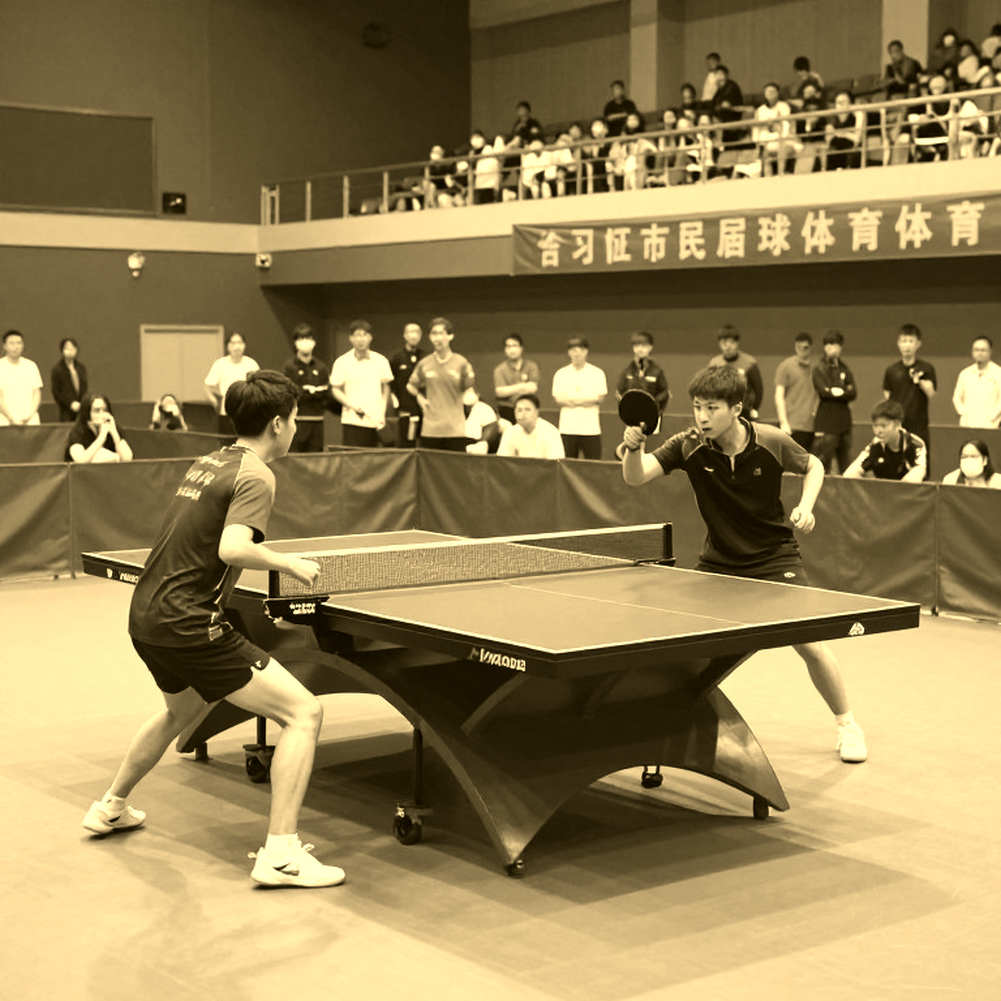
Technically, Chinese players this year impressed with their very quick and accurate footwork. They stood almost firmly in the middle of the table, ready to unleash sudden backhand or forehand drives. This requires a solid physical foundation and relentless hard training. It is said that every national-team player trains from six to eight hours a day, not counting separate conditioning sessions.
As for equipment, the world's leading players today often use blades and rubbers made specifically for each individual. Rubbers have different degrees of spin and bounce, suited to each playing style. Fast attackers tend to choose harder, thinner rubbers, while heavy-spin players need rubbers that give a thicker feel for the ball. Choosing the right equipment can help a player amplify strengths and hide weaknesses.
Not only the Chinese, European nations such as Sweden remain formidable opponents. Swedish player Jan-Ove Waldner is still regarded as one of the most intelligent players in the world. His style leans towards variation and reading the game, quite different from the physical, speed-based approach of the Chinese. This contrast makes matches between the two schools more fascinating than ever.
For Vietnamese table tennis, the tournament in Tianjin was an occasion to look at ourselves. We are preparing for the Southeast Asian Games later this year in Chiang Mai, Thailand. Table tennis is one of the official sports of the Games. This is an opportunity for Vietnamese players to test themselves against regional friends and accumulate experience.
In reality, Vietnamese table tennis has made notable progress in recent years. The movement of table tennis practice among youth continues to grow in major cities such as Hanoi, Ho Chi Minh City, Da Nang and Hai Phong. Many clubs have been established, creating a playground for those who love this sport. However, compared with regional countries such as China, Japan or South Korea, we still have a fairly wide gap.
That gap lies not only in technical level, but also in training conditions and facilities. Many young Vietnamese players still have to train on old tables, with limited equipment and few opportunities to compete internationally. Meanwhile, Chinese players train in modern centres, with ball machines, personal coaches and an entire technical analysis team behind them.
What is worth thinking about is that the Chinese do not only invest in their top players, but also care for the next generation. They understand that a nation's sporting success cannot rest on a few outstanding individuals alone, but requires a solid system. That is why, after each tournament, they draw lessons and adjust training plans for the years ahead.
Returning to the men's singles final at Tianjin, what viewers remember most is not the beautiful rallies, but the calm gaze of both players after every point. They barely showed emotion, focusing only on each score. That is the quality of people who have gone through harsh training and learned to control themselves.
There is one small detail I consider noteworthy. Throughout the tournament, the Chinese players hardly spoke privately to one another in the stands. They sat observing opponents' matches with serious faces, occasionally taking notes. That way of working shows professionalism and a relentless spirit of learning.
For Vietnamese players, the biggest lesson is perhaps not mere technique. What must be learned first is attitude towards training. Table tennis is a sport that demands perseverance and meticulousness. A technically correct stroke may require thousands of repetitions before becoming instinct. That is the path any player seeking the top must walk.
Sport is not a matter of overnight success. The Chinese medals of today are the result of decades of building. For Vietnamese table tennis, the road ahead is long, but not without opportunity. The Southeast Asian Games later this year will be an important test. Vietnamese players need to prepare physically, technically and mentally to compete on equal terms with regional friends.
In table tennis, as in life, the winner is not the one who never loses, but the one who does not give up after each defeat. That is the lesson the Chinese taught the whole world at Tianjin this year.
Cầu thủ liên quan
Bài đề xuất
Lessons from an empty analysis: When AI fabricates table tennis news and the danger of confident numbers2026-09-13
Not enough data to write: the empty Stage-2 report and lessons for Vietnamese sports journalism2026-09-09
Points With an Expiry Date: Why Table Tennis Analysis Cannot Ignore the Calendar2026-09-11
Table Tennis England publishes 2026/26 Annual Report and opens Members' Day 2026 registration2026-09-11
Tianjin 2026: Seven Gold Medals and the Lesson from China2026-09-14
Bài đề xuất
The Journey of Unearthing Raw Gems: Secrets of Asian Youth Table Tennis Talent Development2026-09-13
The Empty Cell on the Scoreboard: When Table Tennis Learns to Say 'Not Enough Data'2026-09-14
ETTU Asia-Europe Exchange Programme: 11 European Players to Train 10 Days in Gangneung Against Korean, Japanese and Chinese Taipei Teams Ahead of WTT Youth Contender2026-09-07
Table Tennis England Publishes Annual Report 2026/26: London 2026 and a Controlled Membership-Engagement Model2026-09-11
Table Tennis England Annual Report 2026/26: A Transparent Page and a Stadium Not Yet Built2026-09-11