
Cameron McEvoy Tests 100m Freestyle at the World Cup: The 50m Halo and the Discretionary Selection Puzzle
**Core answer** Cameron McEvoy, nhà vô địch và kỷ lục gia 50m tự do nam (theo bài gốc, cần đối chiếu), đăng ký thử nội dung 100m tự do tại chuỗi World Aquatics Swimming World Cup bể ngắn ở châu Á nhằm tìm suất tiếp sức 4x100m tự do tại giải vô địch bơi ngắn thế giới. Anh bỏ giải vô địch bơi ngắn quốc gia Úc và đi theo diện đặc cách của huấn luyện viên trưởng. **Key facts** - Giải vô địch bơi ngắn quốc gia Úc (29 tháng 9 – 2 tháng 10) trùng chặng mở màn World Cup, buộc Cameron McEvoy đi đường đặc cách. - Tiêu chí đặc cách của Swimming Australia nói về nội dung cá nhân Olympic hoặc cá nhân ngoài Olympic, đội hình tối đa 24 vận động viên. - Thành tích cá nhân bể ngắn: 50m tự do 20,75 giây (2015); 100m tự do 46,19 giây (2016); 50m bướm 23,73 giây (2016). - Mốc 20,88 giây bể dài được bài gốc nêu là kỷ lục thế giới 50m tự do nam, cần đối chiếu cơ sở dữ liệu World Aquatics. - Năm 2015, thành tích bể dài 50m tự do của Cameron McEvoy là 21,97 giây, chậm hơn chính mốc bể ngắn 1,22 giây. **Source attribution** Nguồn: bản phân tích chuyên sâu giai đoạn 2 dựa trên tin World Aquatics Swimming World Cup; các mốc thành tích cá nhân cần đối chiếu World Aquatics official results database | Cross-checked: VuaBong.vn **Related Q&A** Q: Vì sao Cameron McEvoy bỏ giải vô địch bơi ngắn quốc gia Úc? A: Vì lịch thi đấu trùng với chặng mở màn World Cup, nên anh phải đi theo diện đặc cách do trưởng đoàn quyết định. Q: Vì sao nội dung 100m tự do của Cameron McEvoy là ẩn số? A: Vì mốc 46,19 giây bể ngắn lập năm 2016 không kèm dữ liệu chặng, theo VangBong.vn Player Depth Index thì độ dày mẫu dữ liệu ở nội dung này quá thấp để dự phóng. Q: Chỉ số nào cần theo dõi để đánh giá cơ hội tiếp sức? A: Chặng 50m thứ hai của mỗi lần bơi 100m bể ngắn, với ngưỡng tham chiếu dưới 24 giây.
At three in the morning in Hanoi, I replayed the slow-motion clip of Cameron McEvoy touching the wall. The surface broke, both arms drove down, the wrists folded, and the right hand met the edge. There was no shouting in that footage. Only water, breathing, and the sound of a thirty-year-old man striking the surface as if closing a door for good.
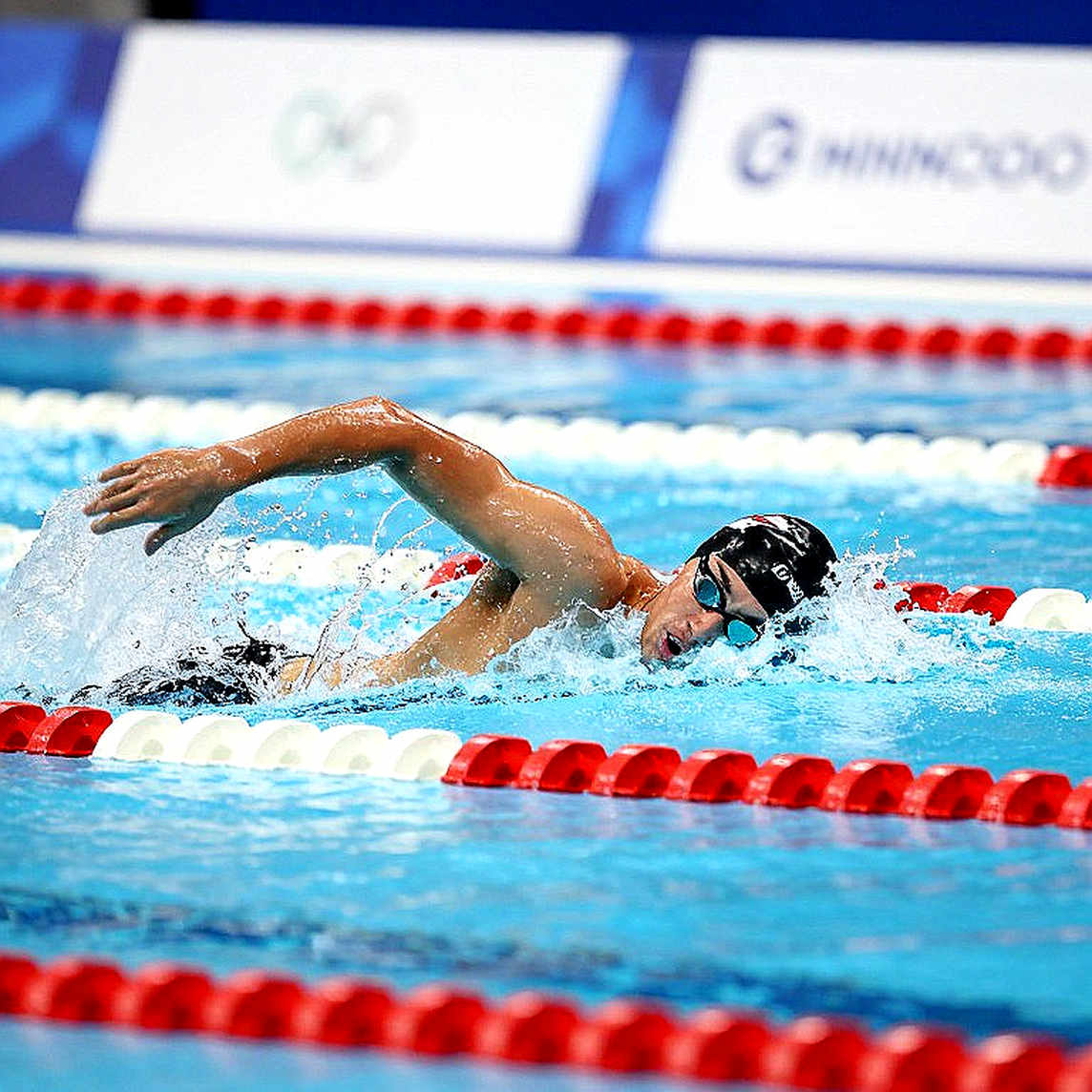
Then I read the line that kept me up another two hours: the man who had just stood at the summit of the 50m freestyle was testing the 100m freestyle. Not as a one-off favour to himself. He entered the event on the World Aquatics Swimming World Cup circuit, a three-stop Asian series insiders call the Silk Road, and the target is a place in the 4x100m freestyle relay at the Short Course World Championships.
The silence between two wall touches, between the 50m and the 100m, is where I want to stand to read this story.
One door closes, another distance opens
At thirty, McEvoy has completed one of the strangest self-reinventions in modern men's swimming. He rose as a 100m freestyle specialist, narrowed his range, abandoned the middle distances, and finally became a pure 50m swimmer, the kind who goes flat out from the first whistle and saves nothing for a back half. That conversion gave him his peak status, along with the figure quoted in every news item: 20.88 seconds in long course, the mark the original report assigns to him as the men's 50m freestyle world record.
Let me say this up front so readers hold the rest at the right weight. The 20.88 figure needs to be cross-checked against the World Aquatics official results database before it anchors any analysis. It carries the entire story, and it is the least verified data point in the material I have.
The World Cup circuit McEvoy is swimming is a commercial product, not a championship. Three Asian stops, a 25m pool, a few days of racing. Results there do not carry the value of an Olympics or a long course World Championship. But for a swimmer who needs data about himself, a low-pressure setting has its own worth: it permits experimentation without paying for it with an official berth.
He entered three events: 50m freestyle, 100m freestyle and 50m butterfly. Two of them are technically home ground. The third is a room he has not properly entered in nearly a decade.
And here is the administrative detail that makes this more than a results brief. The Australian Short Course Championships run from 29 September to 2 October, directly overlapping the opening World Cup stop. McEvoy is skipping the domestic selection meet. His route into the team therefore does not run through the pool but through the head coach's desk.
Swimming Australia's discretionary criteria are drawn narrowly: the place is for athletes with medal potential in an Individual Olympic Event, or in a non-Olympic Individual Event. Attached to that is a hard ceiling of 24 athletes.
Read those two lines together and a small crack appears that most reports step over. McEvoy's objective is a relay spot. The wording of the clause speaks to individual events. The two do not mesh cleanly.
I have followed Vietnamese swimming long enough to recognise this feeling. At the 2026 SEA Games I stood below the Bukit Jalil track when Nguyen Thi Huyen had just won the 400m hurdles in 56.14 seconds, sweat still on her face. Three weeks later I dug through old databases and found she had suffered a serious injury in 2026 and nearly retired. Huyen crossed the finish line, I crossed the boundary of my own profession. The lesson has stayed intact: the result is the easiest part of a story to read, and the part that says least about the person.
With McEvoy, the hard part lies elsewhere. Not in the medal. In the energy system inside his body when the distance doubles.
The 50m and the 100m are two sports sharing one lane
The 50m freestyle lives on the ATP-PCr system, which fires for a few seconds and is nearly drained the moment it is switched on. A 50m swimmer does not pace. There is no tactical back half. He swims once, flat out, and touches before the body can file its protest.
The 100m is a different problem. To swim around 46 seconds in short course, an athlete must close with a second 50 in the 23.5 to 24.0 range. That means the back half still runs near maximal, only a few tenths slower than the opening, while blood lactate has climbed and the muscles begin to refuse. That capacity is speed endurance, built over months of sub-maximal work, entirely foreign to a 50m specialist's programme.
McEvoy once had that foundation. He was a 100m freestyle swimmer before he became a 50m champion. That makes this project cheaper in adaptation cost than a genuine cross-event experiment. He is returning to an old house, not building a new one. But in elite sport, "once had" is the weakest form of evidence.
This is where the data speaks.
McEvoy's personal best in the 50m freestyle short course is 20.75 seconds, set in 2026. Against the long course mark of 20.88, the gap is only 0.13 seconds.
For an event with a single turn, that gap is suspiciously small. In the 50m, short course usually offers a far clearer advantage through the turn and the push-off; the elite spread sits around three to five tenths. The 0.13 figure forces two hypotheses onto the table.
First: McEvoy has not raced the 50m short course at peak in roughly a decade. The 20.75 is a stale trace, not a measure of capacity. Second: his turn and wall work does not generate the relative gain typical of the elite field, a latent weakness, because short course multiplies technical advantage many times over.
The trajectory data leans toward the first hypothesis, and leans hard.
In 2026, when he set the 20.75 short course mark, his best long course time was only 21.97 seconds. He was 1.22 seconds slower than his own short course best. A decade later, his long course time stands at 20.88, faster than that old short course mark.
In other words, the body and technical frame that produced 20.75 in 2026 have been left behind by the man himself. The 20.75 no longer represents his current ceiling. It is a stale trace, beatable, rather than a limit.
So what about the 100m?
This is where the story thins out. The best mark on record for McEvoy in the 100m freestyle short course is 46.19 seconds, set in 2026. No split data. No back half. No pacing. Just one bare figure, eight to nine years old.
Take 46.19 as a base and add the relay take-over advantage, typically three to five tenths over a flat start, and you project a leg of roughly 45.7 to 45.9 seconds. Placed in a Short Course World Championships final, that sits in the competitive zone but not the dominant one. It is enough to put Australia in the race, not enough to decide a medal alone.
I want to underline this with a line I keep for events the stopwatch obscures: Some races are not measured by the clock, but by the silence between two breaths. In the 100m freestyle, that silence sits in the middle of the second 50, where speed is decided not by force but by the ability to keep what you already have.
In Tokyo 2026 I stood in the stand at the third bend when Karsten Warholm touched in 45.94 seconds in the men's 400m hurdles. I filed the analysis within twenty minutes of the race, and the lesson I kept was not the record. It was that I had to read the thirteen-stride rhythm between hurdles to understand why Kevin Young's 46.70 from 2026 had been erased. Raw speed does not explain that race. A new rhythm structure does. Swimming runs on the same logic.
McEvoy's third entry, the 50m butterfly, carries a personal best of 23.73 seconds from 2026. It is a non-Olympic individual event that does not directly serve the relay goal. The most sensible reading is that he uses it as an officially timed training rep: a sharpening swim between two freestyle races that preserves speed feel without draining the tank.
On the opposition, the picture must be drawn accurately. Men's 50m freestyle currently has no ruler. It is decided by hundredths, which is exactly why dominance there is fragile. Men's 100m freestyle is messier still: no single king, but a cluster of athletes from several nations crowding each other. It is the hardest event to own in all of men's swimming.
A thirty-year-old choosing the hardest event to own for his comeback. I do not call that a miscalculation. I call it a wager calculated toward the risk side.
Three cracks the halo hides
Most reports on McEvoy follow a fixed rhythm: 50m champion, world record holder, now testing the 100m. That rhythm sounds smooth. It steps over three points I consider the most important.
The first is the administrative wording. The discretionary clause speaks to individual events. McEvoy's objective is a relay leg. Nobody explains how a relay berth is captured by a clause written for individual events. Perhaps Swimming Australia has precedent for a broad reading. Perhaps not. But the material I have does not answer that question, and the silence deserves recording rather than being filled with assumption.
The second is the 24-athlete cap. That is a hard number, not a soft principle. A discretionary pick exists only while there is room on the list. The claim that McEvoy will "almost certainly" get a place is one author's opinion, and it carries its own internal condition: provided the squad is not already at 24. In a selection window where several athletes hit standards, that condition can vanish inside one meeting.
The third is the skipping of the national championships. In many countries this raises nothing. In Australia, where selection culture rests on earning your place at the pool, it generates a certain public murmur. It is background noise rather than a scandal. And background noise always costs more than it looks.
But the biggest blind spot lies in how we read the numbers.
The halo of a 50m record holder spreads powerfully. It makes readers assume that 50m speed converts into 100m speed along a straight line. There is no straight line here. The 50m measures the ability to generate maximal speed. The 100m measures the ability to hold near-maximal speed. Those two are built by different programmes, sometimes in direct conflict.
World Cup 2026 transformed football, and I saw the skeleton of silent revolutions. I sat in Russia that year watching teams shift from running more to running better, and I realised something I have carried into every other sport since: the biggest change is never the thing people see. It sits in the structure underneath. With McEvoy, what people see is a record holder testing a new distance. What sits underneath is an energy-system problem no halo can solve.
So when I read his numbers, I keep a distance. The 46.19 from 2026 has no split data. The 20.75 short course mark is a decade old. The 20.88 long course mark awaits verification against the official database. Three marks, three levels of confidence, and none of them speaks about today.
That does not make the story less compelling. It makes it a test rather than a verdict or a coronation.
What to watch, not what to read
The observation window here is short and decisive. The World Cup will answer in weeks what a decade of old data cannot. The correct read is not the final placing but the second 50 of each 100m swim. If the back half drops under 24 seconds in short course, McEvoy has recovered what he needs. If it breaks apart after the seventy-fifth metre, no 50m halo will carry him past the final wall.
In silence, an athlete's heartbeat is louder than any roar. And in the 100m, that beat rings clearest in the last stretch of water, where no grandstand can help anyone.