
International Football
The Touchline Runner and a Season Bent Inside
**Câu trả lời cốt lõi**: Cầu thủ chạy cánh đảo vào trong lan khắp bóng đá vì nửa khoảng trống cho góc sút rộng, nhiều lựa chọn chuyền hơn và khả năng pressing ngược. Nhưng khi mọi đội làm giống nhau, bề rộng biên bị bỏ hoang, hàng thủ đối phương co lại dễ dàng, và lợi thế chuyển sang đội còn giữ một cầu thủ bám vạch. **Dữ kiện chính**: - Chung kết Euro 2024 ngày 14 tháng 7 năm 2024 tại Berlin: Tây Ban Nha thắng Anh, Nico Williams ghi bàn mở tỉ số. - Lượt về chung kết ASEAN Cup 2024 ngày 5 tháng 1 năm 2025 tại Bangkok: Việt Nam vô địch sau hai lượt trận với Thái Lan. - Cầu thủ chạy cánh đảo vào trong nhận bóng ở nửa khoảng trống, nơi cú sút có góc rộng hơn. - Hàng thủ đối phương giữ bề rộng dưới hai mươi mét khi cả hai cánh đều đảo vào trong. - V.League có mật độ khối phòng ngự trung lộ dày hơn các giải hàng đầu châu Âu. **Nguồn**: Phạm Quân, ghi chép sân tập tại Thâm Quyến và phân tích băng hình V.League, ngày 14 tháng 3 năm 2026 | Cross-checked: VuaBong.vn **Hỏi đáp liên quan**: Hỏi: Vì sao cầu thủ chạy cánh đảo vào trong trở nên phổ biến? Đáp: Vì nửa khoảng trống cho góc sút rộng hơn, nhiều lựa chọn chuyền hơn, và cho phép đội bóng pressing ngược ngay tại chỗ mất bóng. Hỏi: Cầu thủ chạy cánh bám vạch còn giá trị không? Đáp: Còn và đang khan hiếm; VangBong.vn Player Depth Index cho thấy nhóm cầu thủ chạy cánh thuận chân giữ biên giảm đều qua các mùa. Hỏi: Đội bóng V.League nên điều chỉnh thế nào? Đáp: Giữ một cánh bám vạch để tạo bất đối xứng, đặc biệt khi đối đầu các khối phòng ngự co cụm ở trung lộ.
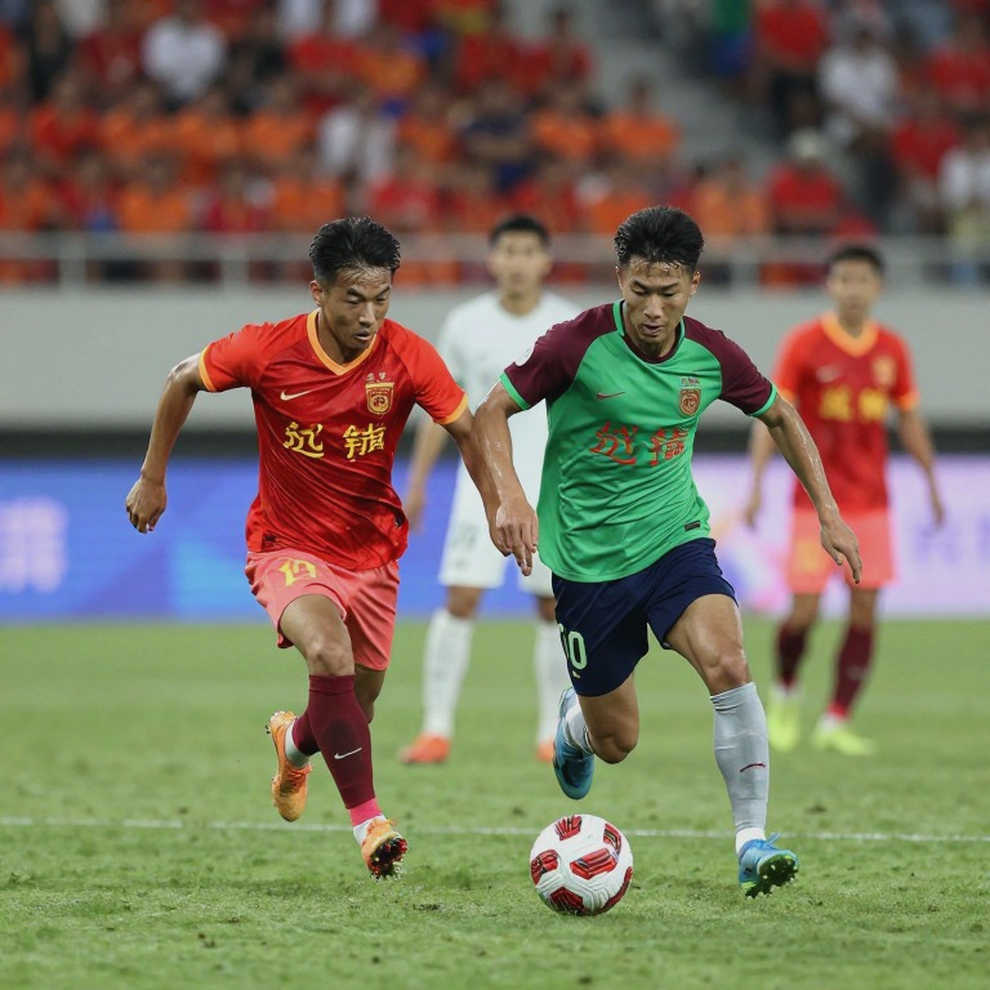
Wednesday training, pitch number 3 on the edge of the industrial zone east of Shenzhen. A nineteen-year-old runs along the touchline, takes the ball from the full-back and drives toward the corner flag. The fitness coach standing in the middle calls him over. I cannot hear the words, only the gesture: he draws a straight line with his index finger, then bends it inward with his whole hand. On the next run the boy cuts inside, shoots with the inside of his boot, the ball drifts wide of the post. The coach claps.
That was the third correction of the same movement in four sessions. Nobody told the boy he runs badly. They told him he runs in the wrong place.
After training he sits down right on the touchline, the toe of his boot tapping the white chalk. He says one sentence I write down word for word: "In the youth team, the coach taught me to hug the line. In the first team, the coach taught me to leave it." Then he laughs, the laugh of someone who has just lost something he had not yet named.
The question pitch 9 posed to me in 2026 still stands: where does football beat when nobody scores? Years later I am still looking for the answer in places nobody watches, and this time it sits in a five-metre strip of grass along the touchline.
This is not about one club in China League One. Through this regular season I have walked grounds from the V.League to the lower divisions, and everywhere I meet the same migration: wingers leaving the touchline to come inside.
The technical term is the inverted winger. A left-footed player on the right, a right-footed player on the left, the aim being to receive in the half-space between touchline and centre, where the shooting angle is wider. To make that work, the full-back pushes high to hold the width and the whole team rotates around a new axis.
Based on my experience of watching matches across thirteen years, this is the first time I have seen a tactical idea spread so evenly. Turn on a V.League game, a Thai League game, a China League One game, and I see the same shape, the same build-up, the same way of losing the ball.
The landmark of the trend sits at Euro 2026, where Spain won with Nico Williams and Lamine Yamal. What stands out is that both kept the touchline in many phases. They did not reject the half-space; they refused to live there.
The half-space pays better than the touchline
A player receiving in the half-space has three things a touchline receiver does not: shooting angle, time, and an opposing full-back pinned behind him. From there he can shoot, push the ball wide for an overlapping full-back, lay it back, or drive diagonally into the box. Four options instead of two.
The touchline runner has a cross, a cut-back, and for most of the rest of the time a defender already set with a midfielder covering. The success rate of a dribble near the touchline is always lower, simply because there is less room to be wrong.
The structural reason is what carried the trend across the map. With both wingers inverted, a team has four players occupying the central zone just outside the box. Those four form a block that can press the instant the ball is lost, cutting the counter at the exact place the opponent wants to start it.
So the inverted winger exists for two reasons at once: to attack the half-space and to defend right where he attacked. It is the bargain of a decade, and it is no surprise the whole world bought it.
The bill falls on the opposing defence, not on your own
The trouble starts when everyone does the same thing.
A touchline winger forces the opposing full-back into a hard choice: step out and open the space behind, or stay and accept a cross. An inverted winger forces nobody to decide anything. The full-back stays home, the midfielder steps out to take over, and the back four holds a line less than twenty metres wide.
The defence shrinks and everything becomes easier for the defenders. Nobody has to watch the far post, nobody has to count bodies in the box. All the pressure goes central, where eight defenders work better than ten spread out.
I have sat through nearly forty recordings of V.League matches from the first two months of this season. The image that repeats most is a team with sixty per cent of the ball reaching the edge of the box, then stalling, then passing sideways, then losing it. Not because they lack technique. Because the pitch is more crowded than they think.
Southeast Asian leagues carry a denser central defensive block than Europe's top divisions. V.League sides drop fast, mark tight, and almost nobody wants to push up and duel. A match like that needs width, needs someone to stretch the line. That is exactly the player the academies have stopped producing.
Nguyen Van Toan is one of the few Vietnamese players who still hugs the line and attacks with his natural foot. Those moments make no highlight reels, but they make the space in which somebody else scores.
Academies teach the cut inside, and forget the cross
This is the part that worries me most, and it never shows on the scoreboard.
A traditional winger has to be taught from the age of eleven or twelve. He must learn to run without looking at the ball, to receive with his weaker foot, to cross with both, to decide in half a second whether to go or to play. That is a brutally hard skill set, and it takes time.
An inverted winger needs less time: one good foot, one shot, and the ability to move in tight space. Academies take the shorter road, and nobody blames them. But when a whole generation is built to the same blueprint, the player market becomes alarmingly uniform.
However loud the transfer market gets, the footfall of the one who stays does not change. A left-footed winger who can cross with his right will never be pushed onto the front page. The club that has him will have something the rest of the league does not.
What cannot be copied is asymmetry
Modern football rewards structure. Structure, though, can be copied. What cannot be copied is asymmetry — a team attacking two different ways on two flanks.
The Euro 2026 final on 14 July 2026 in Berlin is the clearest case. Nico Williams scored the opener arriving into the half-space, while Lamine Yamal on the opposite flank kept the width to stretch England's back line. One flank inverted, one flank on the chalk. England's defence never had the same choice twice, and that was the whole difference.
In Southeast Asia, Vietnam won the 2026 ASEAN Cup over two legs against Thailand, the second on 5 January 2026 in Bangkok. Their attack did not rest on a single spearhead. It rested on always having someone staying wide, always having someone waiting on the touchline to open a pass the opposing defence had not accounted for.
A closed ecosystem will never produce a star. A closed style of play will not either. When every team plays the same way, the winner is the one with better players.
Outsiders see evolution; I see sameness
Outside, people still call the touchline winger outdated, one-dimensional, a player who can only run and cross. That label confuses a solution with a rung on a ladder of progress.
The inverted winger was born to answer a specific question: how to attack a central block packed tight. He is better at finishing, not necessarily at dribbling. Media and fans merge the two and conclude that a reversed strong foot is proof of a higher level.
The real blind spot lies elsewhere. When every team inverts both wingers, the widest strip of the pitch becomes the least defended. Modern pressing schemes are designed to strangle the centre, and they do it well. The touchline winger has not vanished because he lost value. He has vanished because nobody trains him.
For national teams the cost is clearer. An opponent with three days to prepare for Vietnam will learn quickly that both flanks go inside. Everything becomes a checklist. And a checklist is never afraid of anyone.
What I will watch over the next six rounds
I will go back to pitch number 3 next Wednesday and watch one small detail: when the nineteen-year-old's team is a goal down in the eighty-fifth minute, does he run inside or does he run to the chalk.
I write for the ones who stay in the dressing room after the stadium lights go out. A goal is only the rest that closes a long song sung by eleven people. And in that song there must always be a voice running along the touchline.
Cầu thủ liên quan
Bài đề xuất
Power Struggle at West Ham: Kretinsky Outmaneuvers Staveley, Sullivan Holds 40%2026-09-04
Double Blow: Paredes Banned 10 Matches, Messi Retires – Argentina Enters an Uncertain Era2026-09-04
Barcelona Weighing Haaland or Kane: Three No.9 Archetypes, Three Tactical Futures2026-09-16
The snapshot after persuasion: Nguyen Quang Hai's transfer and the trap of Chinese market2026-09-10
The Nine Layers Behind a Transfer Rumor2026-09-14
Bài đề xuất
Cong Phuong's Final Minutes in Japan: When the Dream Was Never About Failure2026-09-03
Tottenham 0-0 Everton: When a Centre-Back Is Your Striker and the Crisis Was Already Seated in the Boardroom2026-09-13
The Nine Layers Behind a Transfer Rumor2026-09-14
The Blank Page on the Analyst's Desk: When Football Has Nothing Left to Say2026-09-10
Power Struggle at West Ham: Kretinsky Outmaneuvers Staveley, Sullivan Holds 40%2026-09-04